NIH Announces Shift Away from Human Fetal Tissue Research to Accelerate Biomedical Innovation
Statement Thursday, January 22, 2026
NIH Announces Shift Away from Human Fetal Tissue Research to Accelerate Biomedical Innovation
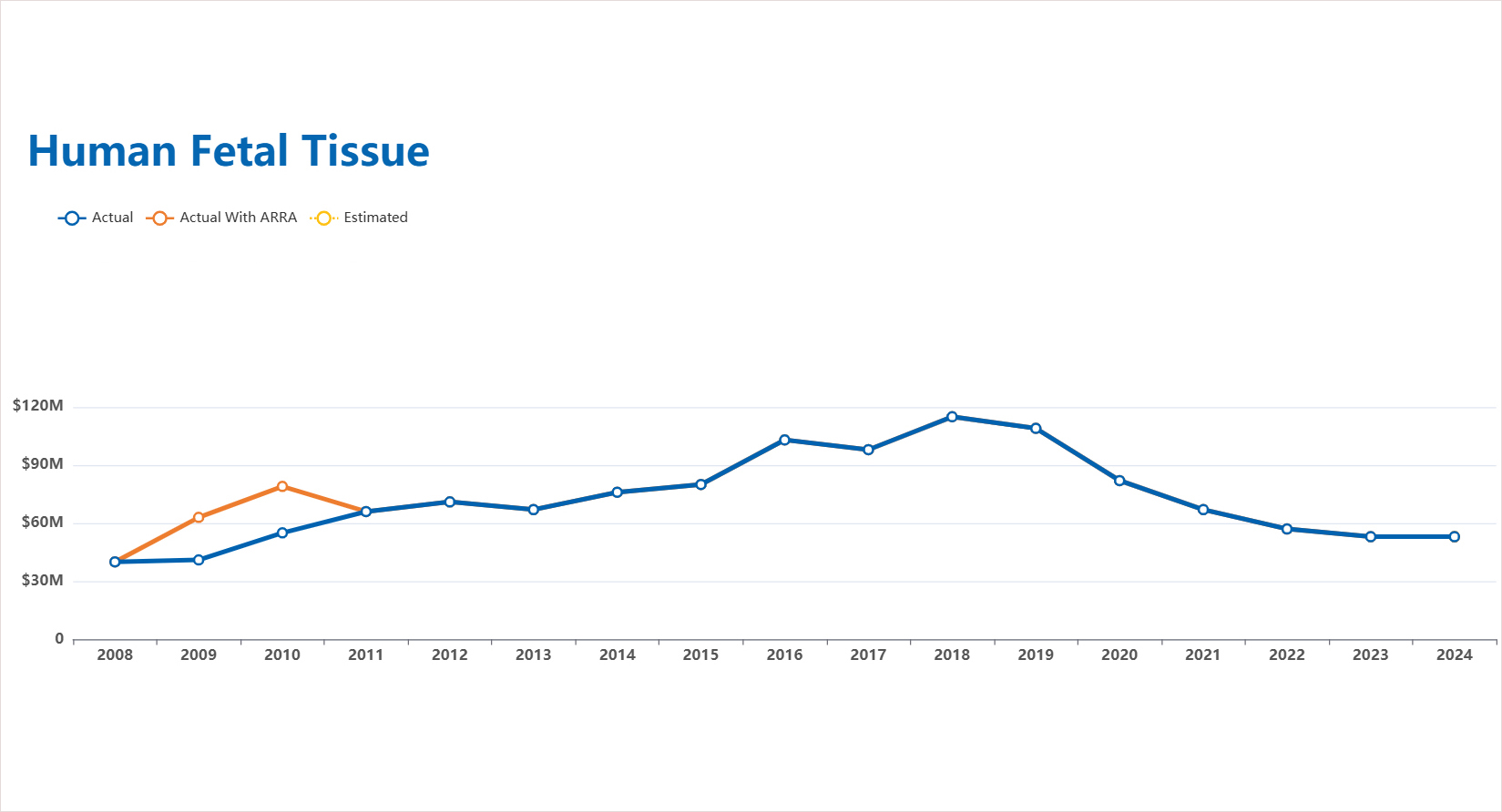
The convergence of validated emerging technologies marks a turning point for biomedical research, opening the door to a fundamental reinvention of scientific practice. To fully realize this future, NIH has undertaken a clear-eyed reassessment of long-standing research approaches to determine their relevance and value in today’s rapidly evolving scientific landscape. Central to this review is NIH’s responsibility to ensure that research supported by taxpayer funds is scientifically rigorous, ethically sound, and justified by a maximal return on the public’s investment.
Through this lens, NIH has reexamined its approach related to the use of human fetal tissue in federally funded research. NIH has long maintained policies governing the responsible and limited use of human fetal tissue in biomedical research. However, NIH supported research using human fetal tissue has been in decline since 2019, with only 77 projects supported in Fiscal Year 2024 (see https://report.nih.gov/funding/categorical-spending#/). Given this sustained decline, the increasing availability of validated alternative technologies, and the need to steward public resources in ways that most effectively drive innovation, NIH will no longer support research using human fetal tissue.
NIH will continue to assess other research areas ripe for modernization and will engage the community in identifying emerging areas in which additional investments could bolstered alternative, validated models. For instance, NIH will soon seek public comment on the robustness of emerging biotechnologies to reduce or potentially replace reliance on human embryonic stem cells. By allocating our resources to more utile technologies we can advance scientific discovery and ensure better health outcomes for all Americans.
Dr. Jay Bhattacharya
NIH Director
About the National Institutes of Health (NIH): NIH, the nation's medical research agency, includes 27 Institutes and Centers and is a component of the U.S. Department of Health and Human Services. NIH is the primary federal agency conducting and supporting basic, clinical, and translational medical research, and is investigating the causes, treatments, and cures for both common and rare diseases. For more information about NIH and its programs, visit www.nih.gov.
NIH…Turning Discovery Into Health®
This page last reviewed on