NIH Leadership
NIH Leadership
The Office of the Director is the central office at NIH, responsible for setting policy for NIH and for planning, managing, and coordinating the programs and activities of all NIH components. The NIH Director, with a unique and critical perspective on the entire agency, is responsible for providing leadership to the Institutes and for constantly identifying needs and opportunities, especially for efforts that involve multiple Institutes. The NIH Director is assisted by NIH Deputy Directors including the Principal Deputy Director, who shares in the overall direction of the agency's activities.
The NIH Director
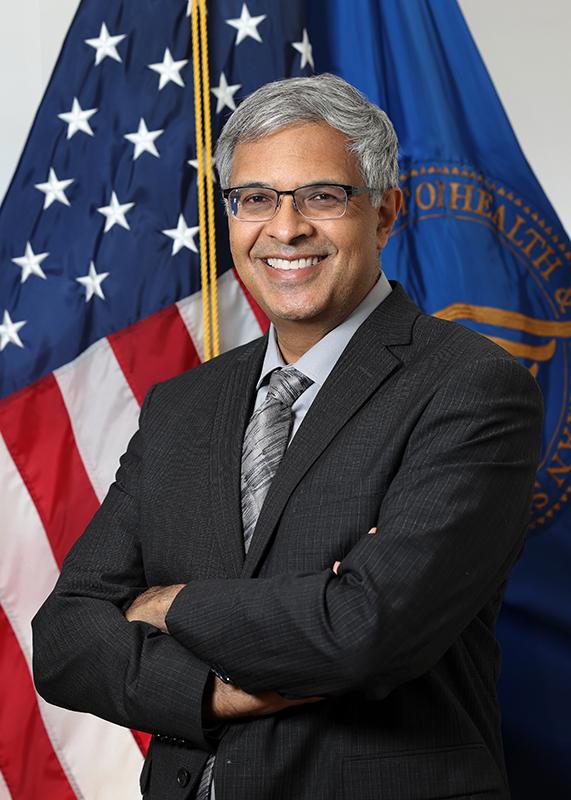
Jay Bhattacharya, M.D., Ph.D. is the 18th director of the National Institutes of Health. President Trump nominated Dr. Bhattacharya for the position on November 26, 2024, the U.S. Senate confirmed him on March 25, 2025, and he took office on April 1, 2025. A health economist and longtime NIH grantee, he previously served as a professor at Stanford University’s School of Medicine and Department of Economics. Read Dr. Bhattacharya’s bio sketch.
Deputy Directors




Institute and Center Directors
Each NIH Institute and Center has its own director to lead the pursuit of the research mission specific to the Institute.
The Role of the NIH Director
The NIH Director plays an active role in shaping the agency's activities and outlook. With a unique and critical perspective on the whole of the NIH, the Director is responsible for providing leadership to the Institutes and for constantly identifying needs and opportunities, especially for efforts that involve multiple Institutes.
The Director stays in touch with each Institute's priorities and accomplishments through:
- regular senior staff meetings,
- discussions with scientific interest groups, and
- briefing sessions with Institute directors.
The Director also seeks advice from the Advisory Committee to the Director, Council of Councils, Scientific Management Review Board, and the Clinical Center Research Hospital Board. These are federal advisory committees comprised of members who are independent of NIH and have the required expertise to advise the NIH Director on major decisions on plans and policies affecting the NIH. The Director also receives advice through discussions with the Administration, usually through the Department of Health and Human Services (HHS), and with the Congress.
The NIH Director is responsible for advising the President on his annual budget request to Congress on the basis of extensive discussions with the Institute Directors.
The position of the NIH Director became presidentially appointed with the passage of the National Cancer Act of 1971 and Senate confirmed with the National Cancer Act Amendments of 1974. Prior to 1971, all NIH Directors were appointed by the Surgeon General, with the exception of Robert Q. Marston, who was appointed by the Secretary of Health, Education, and Welfare.
This page last reviewed on