Cellular Senescence Network (SenNet)
The Common Fund
Cellular Senescence Network (SenNet)
Program Snapshot
One cell dividing into two is a hallmark of development in living beings. However, as we age the tissues in our body accumulate a small number of specialized cells that no longer divide. These cells are called senescent cells, and they play important roles in health and disease across the lifespan. Under certain circumstances, such as aging, senescent cells accumulate and release a collection of molecules that can cause damage to nearby tissue. Under other conditions, such as cancer or wound healing, senescent cells can protect health by preventing tumor growth or releasing molecules that promote the growth of new tissue. Biomedical researchers still have many unanswered questions about how, when, why, and where senescent cells form, but their rarity and diversity make them difficult to identify and characterize in the body. Despite this, senescence is an attractive target for new therapeutics, with some already in development. A deeper understanding of cellular senescence will help researchers to develop further therapies that encourage beneficial effects of senescent cells while suppressing their tissue-damaging effects.
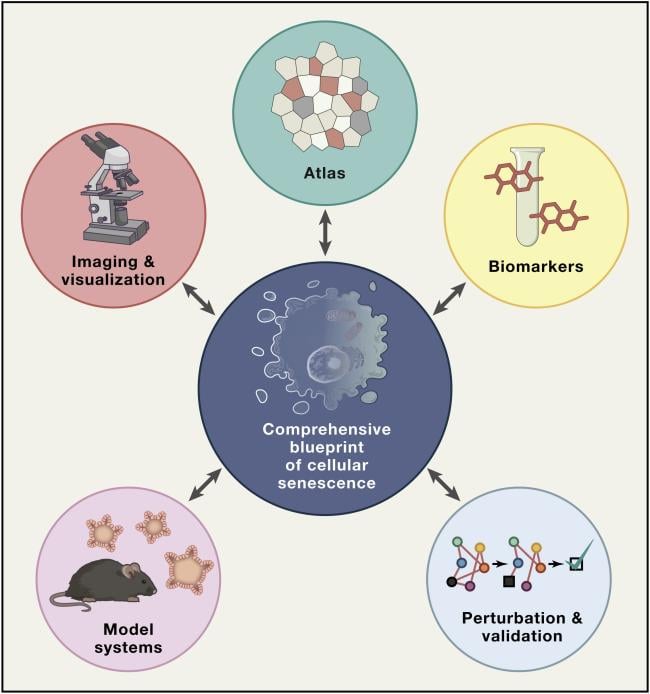
The Common Fund’s Cellular Senescence Network (SenNet) Program was established to comprehensively identify and characterize the differences in senescent cells across the body, across various states of human health, and across the lifespan. SenNet will provide publicly accessible atlases of senescent cells, the differences among them, and the molecules they secrete, using data collected from multiple human and model organism tissues. To identify and characterize these rare cells, SenNet will develop innovative tools and technologies that build upon previous advances in single cell analysis, such as those from the Common Fund’s Human Biomolecular Atlas Program and Single Cell Analysis Program. Lastly, SenNet aims to unite cellular senescence researchers by developing common terms and classifications for senescent cells.
SenNet will provide data and resources to the public that would otherwise be difficult to achieve through individual efforts, accelerating the ability of biomedical researchers to develop therapeutics that target cellular senescence and improve human health.
The SenNet Program Initiatives
- Tissue Mapping Centers: These centers will generate high-resolution, high-content, multiscale biomarkers and maps of cellular senescence across the lifespan and physiological states necessary to generate the Atlas of Cellular Senescence. Each center will have four cores including an Administrative Core, Biospecimen Core, Biological Analysis Core, and Data Analysis Core.
- Technology Development and Application Projects: These projects will develop novel analytics and technologies to identify senescent cells in human tissues.
- Consortium Organization and Data Coordinating Center: This center will serve as an organizational hub for the SenNet consortium. It will store, provide access to, and ensure interoperability and sustainability of the data used in the senescent cell atlases.
SenNet Updates
SenNet Remembers Judith Campisi
Update from the National Institute on Aging (NIA) on SenNet's progress
SenNet Consortium Website
Looking for the latest news and updates from the consortium?
Health Relevance
Cells in the human body divide from one cell into two, allowing the body to create new cells. This can be an important ability, such as when our skin replaces shed cells or a child grows taller. However, researchers have observed that a small number of these once dividing cells suddenly cease to divide, becoming senescent. Although senescent cells do not divide, they remain active. In fact, they may release a large number of molecules, many of which can have effects on nearby cells. Senescent cells play both positive and negative roles in human biology. For example, cellular senescence can be a defense mechanism, like when it stops cancerous cells from multiplying. It also can be helpful by aiding proper wound repair and development of human embryos. However, researchers have shown that senescent cells may contribute to many chronic diseases in older adults, including cardiovascular disease, Alzheimer’s disease, arthritis, lung disease, and kidney disease.
To treat the negative effects of senescent cells, researchers have recently developed a class of drugs called “senolytics” that preferentially kill senescent cells. In animal models, senolytic treatments have resulted in overall improvements in health as well as resistance to a variety of diseases. Clinical trials in humans are currently underway. Nevertheless, there are issues that must be resolved before widespread use of senolytics is possible. Senescent cells show a range of characteristics based on what triggered senescence, the tissue origin of the cell, and where the cell is located in the body. For these reasons it is difficult to identify all senescent cells based on the same criteria. Likewise, a single senolytic cannot target all senescent cells, so specialized approaches will need to be developed. Some senescent cells also play positive roles in human health and removing them with senolytics may be harmful. To understand the origin and function of senescent cells, the NIH Common Fund created the SenNet program, which aims to map senescent cells in multiple normal tissues of human and mice in three dimensions. From this, researchers will know the range of senescent cell characteristics, functions, and where these cells typically occur in the body. Researchers can also use these maps as a reference, to understand how a disease, condition, or therapy affects cellular senescence.
Funded Research
RFA-RM-22-005
In September 2024, the awards below transitioned into their UH3 phase. The UG3 (first phase) of these awards focused on technology development and feasibility, while the UH3 phase will focus on technology application.
| PI Name | Institution Name | Title |
|---|---|---|
| SCHAFER, MARISSA JOY | MAYO CLINIC ROCHESTER | Spatially-resolved protein and transcriptome mapping of senescent cells |
RFA-RM-22-004
In September 2024, the awards below transitioned into their UH3 phase. The UG3 (first phase) of these awards focused on technology development and feasibility, while the UH3 phase will focus on technology application.
| PI Name | Institution Name | Title |
|---|---|---|
| CHRISTIANO, ANGELA M | COLUMBIA UNIVERSITY HEALTH SCIENCES | Senescence-on-a-chip: Building a microphysiological 3D skin model |
| SO, PETER T | MASSACHUSETTS INSTITUTE OF TECHNOLOGY | Single-cell label-free identification of senescence by Raman microscopy and spatial genomics |
| WU, PEI-HSUN | JOHNS HOPKINS UNIVERSITY | Three-dimensional maps of senescence in the human pancreas |
| PI Name | Institution Name | Title |
|---|---|---|
| ADAMS, PETER D (contact) REN, BING |
SANFORD BURNHAM PREBYS MEDICAL DISCOVERY INSTITUTE | Spatial mapping senescent cells across the mouse lifespan by multiplex transcriptomics and epigenomics |
| BERNLOHR, DAVID A (contact) BUDINGER, GR SCOTT KHOSLA, SUNDEEP |
UNIVERSITY OF MINNESOTA | Midwest Murine-Tissue Mapping Center (MM-TMC) |
| DIXIT, VISHWA DEEP (contact) MONTGOMERY, RUTH R |
YALE UNIVERSITY | Yale Murine-TMC on Immune Cell Senescence Derived Inflammation |
| ELISSEEFF, JENNIFER H (contact) BAKER, DARREN DE CABO, RAFAEL |
JOHNS HOPKINS UNIVERSITY | JHU-Mayo-NIA Murine Senescence Mapping Program (JMN-MSMP) |
| ROSENTHAL, NADIA A (contact) KORSTANJE, RONNY ROBSON, PAUL XU, MING |
JACKSON LABORATORY | The Jackson Laboratory Senescence Tissue Mapping Center (JAX-Sen TMC) |
| PI Name | Institution Name | Title |
|---|---|---|
| SILVERSTEIN, JONATHAN C (contact) BAR-JOSEPH, ZIV BLOOD, PHILIP D |
UNIVERSITY OF PITTSBURGH AT PITTSBURGH | Cellular Senescence Network (SenNet) Consortium Organization and Data Coordinating Center (CODCC) |
| PI Name | Institution Name | Title |
|---|---|---|
| CAMPISI, JUDITH (contact) SCHILLING, BIRGIT |
BUCK INSTITUTE FOR RESEARCH ON AGING | Senescent cell mapping, identification and validation for human somatic and reproductive tissues |
| DING, LI (contact) CHEN, FENG FIELDS, RYAN C STEWART, SHEILA A |
WASHINGTON UNIVERSITY | Washington University Senescence Tissue Mapping Center (WU-SN-TMC) |
| FAN, RONG (contact) HALENE, STEPHANIE |
YALE UNIVERSITY | Yale TMC for Cellular Senescence in Lymphoid Organs |
| FINKEL, TOREN (contact) KOENIGSHOFF, MELANIE MORA, ANA LUCIA RAHMAN, IRFAN |
UNIVERSITY OF PITTSBURGH AT PITTSBURGH | TriState SenNET (Lung and Heart) Tissue Map and Atlas consortium |
| KUCHEL, GEORGE A (contact) GAROVIC, VESNA D MUSI, NICOLAS ROBSON, PAUL |
UNIVERSITY OF CONNECTICUT SCH OF MED/DNT | The KAPP-Sen Tissue Mapping Center Collaborative |
| LEE, PATTY J | DUKE UNIVERSITY | The Duke Senescent Cell Evaluations in Normal Tissues (SCENT) Mapping Center |
| NIEDERNHOFER, LAURA JANE | UNIVERSITY OF MINNESOTA | Minnesota Tissue Mapping Center for Senescent Cells |
| PHATNANI, HEMALI (contact) CHRISTIANO, ANGELA M MENON, VILAS SUH, YOUSIN |
COLUMBIA UNIVERSITY HEALTH SCIENCES | A Multi-scale Atlas of Senescence in Diverse Tissue Types |
Related Links
This page last reviewed on