INCLUDE Voices: Research in Action Challenge
INCLUDE Voices: Research in Action Challenge
Your stories in motion. Your health in focus.
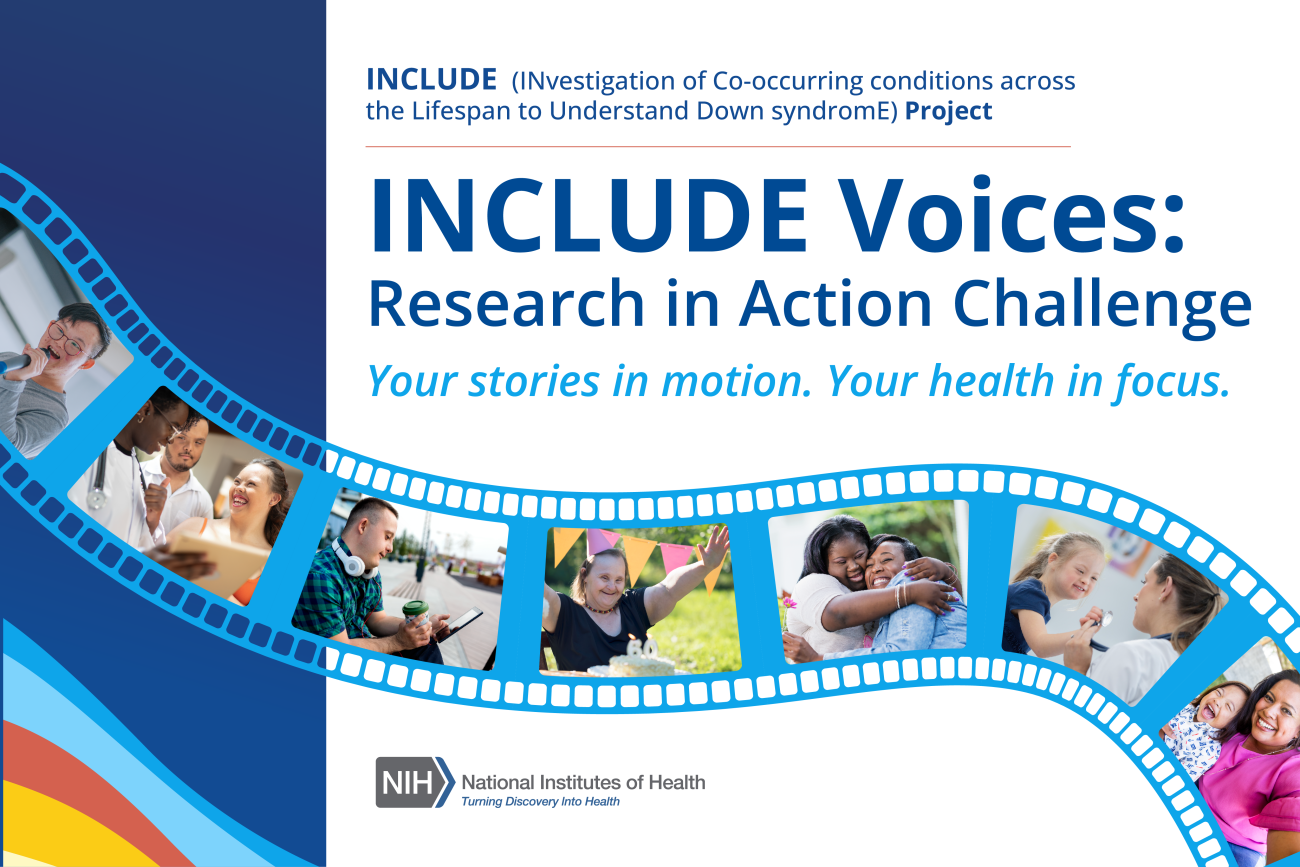
The “INCLUDE Voices: Research in Action Challenge” invites people with Down syndrome, families, caregivers, researchers, clinicians, students, advocacy organizations, and other members of the Down syndrome community to create original content that brings research to life.
Submission open 10/05/26 to 12/18/26
Total Prize: Up to $50,000
Description
Subject of the Challenge
Scientific research is transforming our understanding of Down syndrome and its co-occurring conditions, leading to discoveries that improve health, well-being, and quality of life across the lifespan. The “INCLUDE Voices: Research in Action Challenge” invites people with Down syndrome, families, caregivers, researchers, clinicians, students, advocacy organizations, and other members of the Down syndrome community to create original content that brings research to life. Through storytelling, creative media, and science communication, participants will help explain how research is improving lives, encourage greater participation in research, and inspire conversations about the future of Down syndrome research.
Down syndrome is a genetic condition in which a person is born with an extra copy of chromosome 21. It is the most common chromosomal condition in the United States, affecting approximately 1 in every 700 births — about 6,000 babies each year. Within the past 25 years, the average lifespan for a person with Down syndrome has doubled, from 30 to 60 years. As people with Down syndrome live longer and healthier lives, research is helping us better understand their health needs across the lifespan and develop new ways to improve care, support, and quality of life.
Having an extra copy of chromosome 21 can affect virtually every tissue and organ throughout a person's life. This gives rise to what researchers call co-occurring conditions: health conditions that appear alongside Down syndrome at rates that differ from the general population. On average, for people with Down syndrome, some conditions occur more frequently, like Alzheimer's disease and congenital heart disease. Others occur far less frequently, like certain tumors. Understanding these unique risks and resiliencies has the potential to transform care for people with Down syndrome and to unlock discoveries that benefit everyone.
A challenge, also known as a prize competition, is an open call for the public to solve a problem or communicate an idea, where the best submissions are recognized with a prize. Unlike NIH grants, challenge prizes can offer unrestricted cash awards, meaning winners can use the money however they choose, with no reporting requirements or programmatic conditions attached. NIH conducts challenges like this one to reach beyond the traditional scientific community and invite fresh perspectives from anyone with something meaningful to contribute. By opening the door to a broad range of voices and talents, challenges help NIH find innovative solutions that might not emerge through conventional funding mechanisms.
This challenge is part of the National Institutes of Health (NIH) INCLUDE (INvestigation of Co-occurring conditions across the Lifespan to Understand Down syndromE) Project, a NIH-wide initiative that aims to expand knowledge about Down syndrome and its co-occurring conditions, increase participation of people with Down syndrome and their families in research, and ultimately improve the health and quality of life of people with Down syndrome. Through collaboration between the Down syndrome and scientific communities, the INCLUDE Project advances research across the lifespan and expands our understanding of Down syndrome and health conditions that occur alongside Down syndrome.
The Challenge
The INCLUDE Project invites people with Down syndrome, families, caregivers, researchers, clinicians, students, advocacy organizations, and other members of the Down syndrome community to share their knowledge, creativity, and perspectives of research through short video entries that communicate how Down syndrome research improves health, informs care, expands opportunity, and enhances quality of life across the lifespan. Whether explaining why research participation matters or sharing how research has influenced everyday life, your videos can help make research more understandable, engaging, and accessible to a broad audience.
Submissions may address any of the following themes (this list is not exhaustive):
- Why Research Participation Matters: Explain why research participation is important, what it is like to take part in a clinical trial or other research study, how participants help advance scientific discoveries, and how people can get involved.
- From Discovery to Real-World Impact: Demonstrate how research findings are translated into therapies, interventions, services, support technologies, education, policies, health care practices, greater independence, employment, quality of life, or other improvements that benefit people with Down syndrome and their families.
- Research that Benefits Everyone: Show how discoveries from research on Down syndrome and its co-occurring conditions are expanding scientific knowledge and leading to advances that improve health and quality of life for people with Down syndrome while also benefiting the broader population.
- Research Across the Lifespan: Highlight the importance of studying Down syndrome throughout life, from infancy to adulthood, to better understand health, development, aging, and quality of life.
- Research During Life Transitions: Explore why research is needed during key life transitions, such as early childhood, adolescence, adulthood, employment, supported or independent living, and healthy aging.
- Women’s Health and Down Syndrome: Raise awareness about the importance of research on women’s health throughout the lifespan, including puberty, menstrual health, hormonal changes, fertility, pregnancy, perimenopause, menopause, and healthy aging.
- Building Inclusive Research Teams: Show how people with Down syndrome contribute to research as research assistants, advisors, educators, ambassadors, or other members of research teams. Highlight how their perspectives and experiences help create more welcoming, inclusive, and participant-centered research and strengthen connections between researchers and the Down syndrome community.
- Partnerships That Advance Research: Share stories that demonstrate how people with Down syndrome, families, caregivers, researchers, clinicians, advocacy organizations, and other partners work together to advance research and improve lives.
Appropriate communication vehicles (video formats) include, but are not limited to:
- Documentary-style short film
- Animation or motion graphics
- Dramatic reading or spoken word including use of Augmentative and Alternative Communication (such as sign language) to convey the message
- Interview or personal testimony
- Explainer video
- Music video or song with visual accompaniment
Submissions should be tailored to individuals with Down syndrome, their families, and their loved ones.
Each individual, team, or entity may submit only one (1) entry, limited to 3 minutes in duration.
Note: Entries must not use the logo or official seal of HHS or NIH and must not claim federal government endorsement.
Statutory Authority to Conduct the Challenge
The NIH Office of the Director is conducting this Challenge under the America Creating Opportunities to Meaningfully Promote Excellence in Technology, Education, and Science (COMPETES) Reauthorization Act of 2010, as amended [15 U.S.C. § 3719]. The INCLUDE Project is a component of the NIH Office of the Director budget, which is managed by the Director’s Office, Division of Program Coordination, Planning, and Strategic Initiatives and is supported by the NIH-wide Down syndrome Working Group.
The INCLUDE Project was launched in June 2018 in support of a Congressional directive in the fiscal year (FY) 2018 Omnibus Appropriations. It aims to increase participation of people with Down syndrome and their families in clinical research, expand knowledge about Down syndrome and its links to other health conditions, and improve the health of individuals with Down syndrome. INCLUDE supports people with Down syndrome and their communities by supporting research on basic science, cohort studies and clinical trials. It is beneficial to all stakeholders for INCLUDE to optimize the communication tools available to support effective information dissemination and education on research participation. This Challenge will lead to innovative ways to communicate with others and to educate people about the value of Down syndrome research through accessible video media.
Timeline
- Challenge Launch: September 23, 2026
- Submission Start/End: October 5, 2026/December 18, 2026
- Judging Start/End: January 2027/February 2027
- Winners Announced: March 21, 2027
Prizes
Amount of the Prize: The total cash prize purse for this challenge is up to $50,000, distributed across the following categories following the successful completion of the Challenge:
- Up to one (1) Grand Prize Award of up to $10,000
- Up to five (5) Excellence Awards of up to $4,000 each
- Up to ten (10) Impact Awards of up to $2,000 each
The Grand Prize will recognize the submission that most powerfully communicates the value of Down syndrome research and presents an exceptionally compelling vision of how research improves health and quality of life for people with Down syndrome. The winning entry excels across all judging criteria by combining clear scientific communication, strong storytelling, and meaningful engagement with the Down syndrome community.
The Excellence Award will recognize outstanding submissions that effectively communicate Down syndrome research or improve public understanding of how research enhances health and quality of life for people with Down syndrome. These entries demonstrate accuracy, clarity, and creativity in explaining Down syndrome research and translating complex concepts into content that is engaging and accessible to a broad audience.
The Impact Award will recognize submissions that show exceptional promise in advancing awareness of Down syndrome research or inspiring participation in research. These entries are distinguished by their ability to connect with the Down syndrome community, motivate research participation, and spark meaningful conversations.
In addition to monetary prizes, NIH may provide non-monetary recognition in the form of an honorable mention for submissions that demonstrate creativity, innovation, and/or community impact.
Winners are expected to be notified by World Down Syndrome Day on March 21, 2027, and recognized during the 2027 NIH INCLUDE Investigators Meeting on April 19-20, 2027. Winners will be invited to attend the 2027 NIH INCLUDE Investigators Meeting for this recognition (travel costs not included).
Award Approving Official:
The Award Approving Official will be the Director of the Division of Program Coordination, Planning, and Strategic Initiatives within the NIH Office of the Director, or as otherwise delegated.
Payment of the Prize:
Prizes awarded under this Challenge will be paid by electronic funds transfer and may be subject to federal income taxes. The Department of Health and Human Services (HHS)/NIH will comply with the Internal Revenue Service withholding and reporting requirements, where applicable. Entities participating in this Challenge are encouraged, but not required, to request and obtain a free Unique Entity ID (UEI), if they have not already done so, via SAM.gov as this will expedite prize payment. Additional information can be found at https://sam.gov/content/entity-registration.
NIH reserves the right, in its sole discretion, to (a) cancel, suspend, or modify the Challenge, or any part of it, for any reason, and/or (b) not award any prizes if no submissions are deemed worthy.
Rules
Eligibility Rules
To be eligible to win a prize under this Challenge, a Participant (whether participating as an Individual, Team, or Entity):
- Shall have registered to participate in the Challenge under the rules promulgated by the National Institutes of Health (NIH) as published in this announcement;
- Shall have complied with all the requirements set forth in this announcement;
- In the case of a private entity, shall be incorporated in and maintain a primary place of business in the United States, and in the case of an individual, whether participating singly or in a group, shall be a citizen or permanent resident of the United States. However, non-U.S. citizens and non-permanent residents can participate as a member of a team that otherwise satisfies the eligibility criteria. Non-U.S. citizens and non-permanent residents are not eligible to win a monetary prize (in whole or in part). Their participation as part of a winning team, if applicable, may be recognized when the results are announced;
- Shall not be a federal entity or federal employee acting within the scope of their employment;
- Shall not be an employee of the Department of Health and Human Services (HHS, or any other component of HHS) acting in their personal capacity; Individuals employed by a federal agency or entity other than HHS (or any component of HHS), should consult with an agency ethics official to determine whether the federal ethics rules will limit or prohibit the acceptance of a prize under this Challenge;
- Shall not be a judge of the Challenge, or any other party involved with the design, production, execution, or distribution of the Challenge or the immediate family of such a party (i.e., spouse, parent, step-parent, child, or step-child);
- Shall be 18 years of age or older at the time of submission.
Participation Rules
- Federal grantees and recipients of cooperative agreements or other transaction (OT) awards are eligible to participate in the Challenge but may not use Federal funds from a grant award, cooperative agreement, or OT award to develop their Challenge submission or to fund efforts in support of their Challenge submission unless use of such funds is consistent with the purpose, terms, and conditions of the grant award, cooperative agreement, or OT award. Each Participant intending to use Federal grant, cooperative agreement, or OT award funds must register for and participate in the Challenge as an Entity on behalf of the awardee institution, organization, or entity. If a winning Participant uses Federal grant, cooperative agreement, or OT award funds to participate in the Challenge, the prize must be treated as program income for purposes of the original grant, cooperative agreement, or OT award in accordance with applicable Uniform Administrative Requirements, Cost Principles, and Audit Requirements for Federal Awards [2 CFR § 200]. Participants using Federal grant, cooperative agreement, or OT award funds to participate and/or report prize funding as program income (for winning Participants) should coordinate with the awarding official at the federal awarding agency.
- Federal contractors may not use federal funds from a contract to develop their Challenge submissions or to fund efforts in support of their Challenge submissions.
- By participating in this Challenge, each Participant (whether participating as an Individual, Team or Entity) agrees to assume any and all risks and waive claims against the federal government and its related entities, except in the case of willful misconduct, for any injury, death, damage, or loss of property, revenue, or profits, whether direct, indirect, or consequential, arising from participation in this Challenge, whether the injury, death, damage, or loss arises through negligence or otherwise.
- Based on the subject matter of the Challenge, the type of work that it will possibly require, as well as an analysis of the likelihood of any claims for death, bodily injury, property damage, or loss potentially resulting from Challenge participation, no Participant (whether participating as an Individual, Team or Entity) participating in the Challenge is required to obtain liability insurance, or demonstrate financial responsibility, or agree to indemnify the federal government against third party claims for damages arising from or related to Challenge activities in order to participate in this Challenge.
- A Participant (whether participating as an Individual, Team or Entity) shall not be deemed ineligible because the Participant used federal facilities or consulted with federal employees during the Challenge if the facilities and employees are made available to all Participants participating in the Challenge on an equitable basis.
- By participating in this Challenge, each Participant (whether participating as an Individual, Team or Entity) warrants that they are sole author or owner of, or has the right to use, any copyrightable works that the submission comprises, that the works are wholly original with the Participant (or is an improved version of an existing work that the Participant has sufficient rights to use and improve), and that the submission does not infringe any copyright or any other rights of any third party of which the Participant is aware.
- By participating in this Challenge, each Participant (whether participating as an Individual, Team or Entity) grants to the NIH an irrevocable, paid-up, royalty-free nonexclusive worldwide license to reproduce, publish, post, link to, share, and display publicly the submission on the web or elsewhere. Each Participant will retain all other intellectual property rights in their submissions, as applicable. To participate in the Challenge, each Participant must warrant that there are no legal obstacles to providing the above-referenced nonexclusive licenses of the Participant’s rights to the federal government. To receive an award, Participants will not be required to transfer their intellectual property rights to NIH, but Participants must grant to the federal government the nonexclusive licenses recited herein.
- Each Participant (whether participating as an Individual, Team, or Entity) agrees to follow all applicable federal, state, and local laws, regulations, and policies.
- Each Participant (whether participating as an Individual, Team, or Entity) participating in this Challenge must comply with all terms and conditions of these rules, and participation in this Challenge constitutes each such Participant’s full and unconditional agreement to abide by these rules. Winning is contingent upon fulfilling all requirements herein.
- As a condition for winning a cash prize in this Challenge, each Participant (whether participating as an Individual, Team, or Entity) that has been selected as a winner must complete and submit all requested winner verification and payment documents to NIH within 20 business days of formal notification. Failure to return all required verification documents by the date specified in the notification may be a basis for disqualification of a cash prize winning submission.
Judging Criteria
Basis Upon Which a Winner Will be Selected
Only materials in the submission package will be assessed by the judges. Submission packages must include the registration form, the cover letter and the video. Submission packages that do not include any of the items listed will not be judged.
A panel of technical experts with subject matter expertise relevant to the Challenge goals will evaluate submissions based on their ability to fulfill the criteria listed below. The entries will then be ranked and the winners selected by a panel of federal employees serving as competition judges, which may include NIH program staff, subject to the final decision by the Award Approving Official.
- Completeness – 10 points
- To what extent does the submission fulfill all requirements outlined in the submission requirements section?
- Importance of Down syndrome Research – 30 points
- How compellingly does the entry convey why Down syndrome research matters — not only for individuals with Down syndrome, but potentially for a broader audience?
- How well does the entry explain how Down syndrome research improves health, informs care, expands opportunity, and supports individuals with Down syndrome?
- To what extent does the entry encourage informed participation in research within the Down syndrome community?
- Creativity and Originality – 30 points
- To what degree does the entry demonstrate creative thinking in addressing the challenge?
- How engaging and memorable is the entry as a communication piece?
- How fresh or unexpected is the perspective the entry brings to the subject matter?
- Reach and Dissemination Potential – 30 points
- How authentically does the entry reflect the perspectives and experiences of individuals with Down syndrome and their communities?
- How likely is it that the entry could serve as an effective communication vehicle that appeals to a broad audience and is easy to share and disseminate across platforms?
- How clear and accessible is the language used, including adherence to person-first language?
How to Enter
Registration Process: The official announcement for the INCLUDE Voices: Research in Action Challenge can be found on nih.gov/challenges. The Challenge registration and submission portal is administered by a third-party vendor operating under a contract with the NASA Center of Excellence for Collaborative Innovation (CoECI). Innovators can access the online portal by first going to https://work.crowdplat.com/challenge/nih-include-voices.
To register, Participants will first be directed to establish an account in the portal at https://work.crowdplat.com/challenge/nih-include-voices. Participants will be required to identify whether they are registering as either of the following: as an Individual, as an independent Team (i.e., registering as a group of individuals competing together but not on behalf of an established organization, institution, or corporation) or as an Entity (i.e., registering as a group of individuals competing together on behalf of a legally established organization, institution, or corporation). Participants will need to provide the name, affiliation, and contact information of all individuals competing in this Challenge as part of a Team or on behalf of an Entity. All Participants will also be required to acknowledge whether federal funding will be used in the development of the Challenge submission (see Participation Rule 1). All Participants must certify they have read, understand, and agree to abide by the official eligibility rules, participation rules, and requirements for the Challenge as stated in this announcement.
- For Individuals: To be eligible to receive a cash prize, the Individual must be a citizen or permanent resident of the United States.
- For Teams: Each participating Team is required to identify a Team Captain who will register and submit on behalf of the Team members. The Team Captain is responsible for all communications with the Challenge sponsors and, in the event of winning a cash prize, will be paid the prize in full. To be eligible to receive a cash prize, the Team Captain must be a citizen or permanent resident of the United States. In the event that a dispute regarding the identity of the Team Captain who actually submitted the entry cannot be resolved to NIH’s satisfaction, the affected submission will be deemed ineligible.
- For Entities: Each participating Entity is required to identify a Point of Contact who will register and submit on behalf of the Entity. The Point of Contact is responsible for all communications with the Challenge sponsors. In the event of winning a cash prize, the prize will be paid directly to the Entity, not to the Point of Contact. To be eligible to receive a cash prize, the Entity must be incorporated in and maintain a primary place of business in the United States. As stated in the Participation Rules, Innovators intending to use Federal grant, cooperative agreement, or OT funds must register for and participate in the Challenge as an Entity on behalf of the awardee institution or organization. In the event that a dispute regarding the identity of the Point of Contact who actually submitted the entry cannot be resolved to NIH’s satisfaction, the affected submission will be deemed ineligible.
Submission Requirements:
Once Participants have completed the registration step and established an account in the online submission portal at the link above, they must provide the following as their formal submission:
Cover Letter (1 page)
Participants must provide a PDF copy of their cover letter as part of the submission package. Narratives must be no longer than 1 page, with one-inch margins. Font size must be no smaller than 11-point Calibri. All submissions must be in English. Entries must not use the HHS logo or official seal or logo of NIH and must not claim federal government endorsement.
The Cover Letter must address the following:
- Include affiliation, and contact information for the Individual, Team Captain or Entity POC submitting the entry.
- Describe how the submission addresses the Challenge; specifically, how the entry communicates the value and impact of Down syndrome research and encourages informed participation in research.
- Describe the target audience and propose a dissemination plan for the entry to reach as many people as possible.
- Explain why the selected communication vehicle (video format) was chosen and how it is suited to the intended audience.
- Describe any collaborations, including with people with Down syndrome, that contributed to producing the final entry and the nature of those collaborations.
Video
Participants must submit a short video, no longer than 3 minutes in duration, that communicates the value and impact of Down syndrome research. Videos must be submitted as a digital file or via a private streaming link (e.g., YouTube, Vimeo) not accessible to the public. Appropriate video formats include, but are not limited to:
- Documentary-style short film
- Animation or motion graphics
- Dramatic reading or spoken word including use of Augmentative and Alternative Communication (such as sign language) to convey the message
- Interview or personal testimony
- Explainer video
- Music video or song with visual accompaniment
Each individual, team, or entity may submit only one (1) video entry, and each video entry is limited to a maximum of 3 minutes in duration.
Participants must complete their submission and provide all of the requested information in the portal no later than 11:59 PM Eastern Time on December 18, 2026. Participants who do not submit their complete submission via the portal by this deadline will not have their submission considered for this Challenge.
Contact
For Further Information Contact: [email protected]
This page last reviewed on