Sensory nerves play role in bone fracture healing
February 10, 2026
Sensory nerves play role in bone fracture healing
At a Glance
- A study in mice found that after a bone fracture, the nerves that sense pain also promote healing by signaling for bone repair and wound healing.
- The findings could lead to new treatments that stimulate bone repair and might be used to drive bone formation in bone disorders such as osteoporosis.
Bone fractures are common, with millions occurring nationwide each year. Aging and conditions such as diabetes or obesity may cause bones to heal slowly or lead to complications during the healing process that can lead to long-term disability. A better understanding of the bone-healing process could help scientists identify targets for new medications to improve healing.
Recent studies suggest that sensory nerves, which perceive pain, may contribute to the healing process in bone near a fracture site. In an NIH-funded study, researchers led by Dr. Aaron James of the Johns Hopkins University School of Medicine explored the role of sensory nerves in bone healing. Results were published in Science on January 8, 2026.
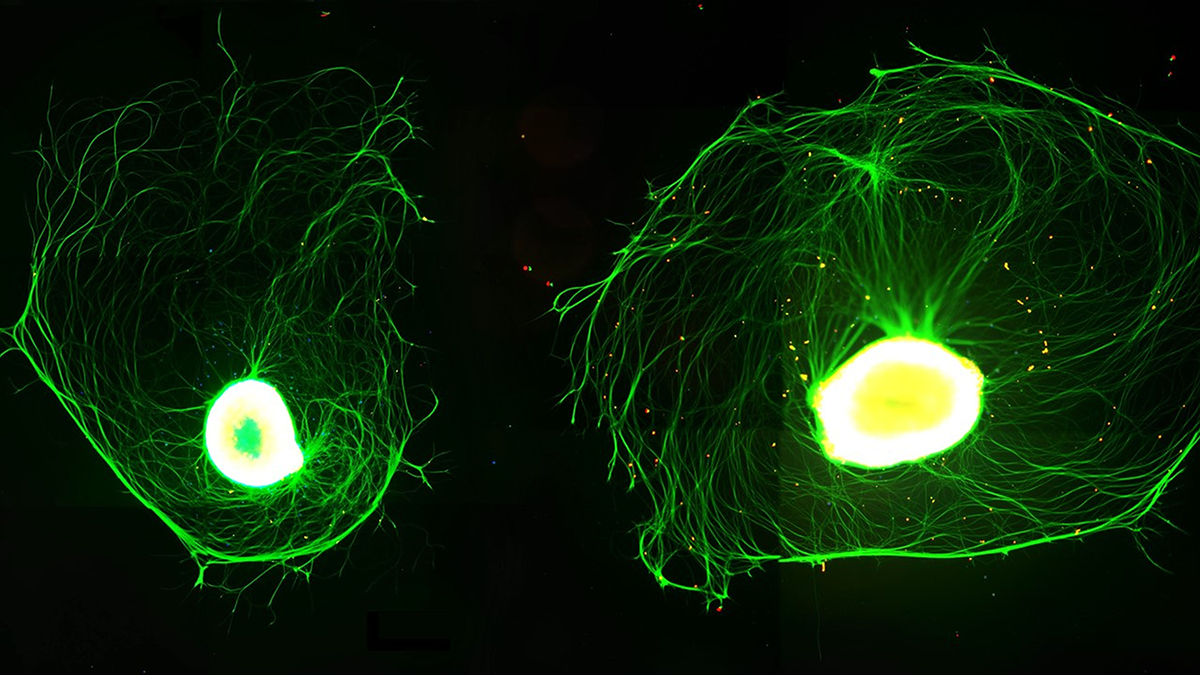
The research team used a process called retrograde tracing to identify which dorsal root ganglion (DRG) neurons, which run along the spinal cord, extend into mouse limb bones. They then closely examined gene activity in these DRG neurons at different points during the healing process. Neurons were tested before the fracture occurred and then at one, 14, and 56 days after the fracture. The time points were chosen to capture different phases of bone repair.
The day after a fracture occurred, these DRG neurons showed increased activity in genes related to pain perception and inflammation pathways. Later changes in gene activity were associated with signals for bone healing and regeneration.
Disabling the neurons in the limb bone, either surgically or chemically, impaired fracture healing. This was a result of reduced bone-forming activity by relevant cells. The team next did an analysis of the interactions between these cells and DRG neurons. They identified a protein called neuron-derived fibroblast growth factor 9 (FGF9) as the signal from DRG neurons that drives fracture repair. Interfering with FGF9, either by deactivating or deleting the Fgf9 gene in DRG neurons, impaired bone repair in mice.
These findings could lead to treatments that trigger sensory neurons to release signals that promote bone repair. These could be used to treat difficult fractures or even certain bone disorders, such as osteoporosis.
“Just after injury, DRG neurons are nociceptors, nerves that produce signals focused on pain perception and inflammatory responses,” says co-lead author Dr. Zhao Li. “But then at later timepoints, they enter a different phase, a pro-regenerative state, where they produce and release proteins that promote the generation of new neurons, blood vessels, and of course, bone and cartilage.”
Further work will be needed to understand how age and diseases such as diabetes affect the signals from DRG neurons to contribute to problems in bone healing.
—by Sarah Mann
Related Links
- 3D-printed bioreactor builds bone
- Genes linked to abnormal bone density and fracture
- Human skeletal stem cell identified
- Tendon trouble: Finding a fix for injured tissue
- Why aging matters for bone healing: New clues from the rib
- Building back broken bones
- Regeneration
References
Mapping somatosensory afferent circuitry to bone identifies neurotrophic signals required for fracture healing. Xu M, Li Z, Thottappillil N, Cherief M, Zhu M, Xing X, Gomez-Salazar M, Rao C, Ramesh S, Mwirigi JM, Sankaranarayanan I, Tavares-Ferreira D, Zhang C, Wang XW, Archer M, Guan Y, Tower RJ, Cahan P, Price TJ, Clemens TL, James AW. Science. 2026 Jan 8;391(6781):eadr9608. doi: 10.1126/science.adr9608. Epub 2026 Jan 8. PMID: 41505527.
Funding
NIH’s National Institute of Arthritis and Musculoskeletal and Skin Diseases (NIAMS) and National Institute of Dental and Craniofacial Research (NIDCR); U.S. Department of Defense; Maryland Stem Cell Research Foundation; Alex’s Lemonade Stand Foundation; American Cancer Society.