Brain-computer device helps man speak
July 14, 2026
Brain-computer device helps man speak
At a Glance
- A man unable to talk due to paralysis successfully used a brain-computer interface system at his home to speak.
- This technology could become a practical communication tool for people who can’t talk because of problems with their muscles.
Losing the ability to talk and communicate can be devastating for people with amyotrophic lateral sclerosis (ALS) and other conditions that cause paralysis. Alternative communication devices are available to help people express themselves. They can range from simple picture boards to computer programs that synthesize speech from text. However, these devices have limitations. They can be slow, have limited vocabulary, or depend on some movement of the hands, face, or eyes.
To address these limits, scientists developed brain-computer interfaces as a new kind of alternative communication device. They translate brain activity directly into words. Electrodes are placed across the motor cortex, the part of the brain that controls speech and other body movements. The electrodes sense the brain signals as a person tries to talk. The device then translates the signals into words. This approach has shown promise in controlled laboratory settings.
An NIH-funded research team led by Drs. Sergey Stavisky and David Brandman at the University of California, Davis, set out to test a brain-computer interface in a real-world setting: a trial participant’s home. The study was part of an ongoing clinical trial testing the safety and feasibility of a brain-computer interface for people with paralysis. Results were published in Nature Medicine on June 15, 2026.
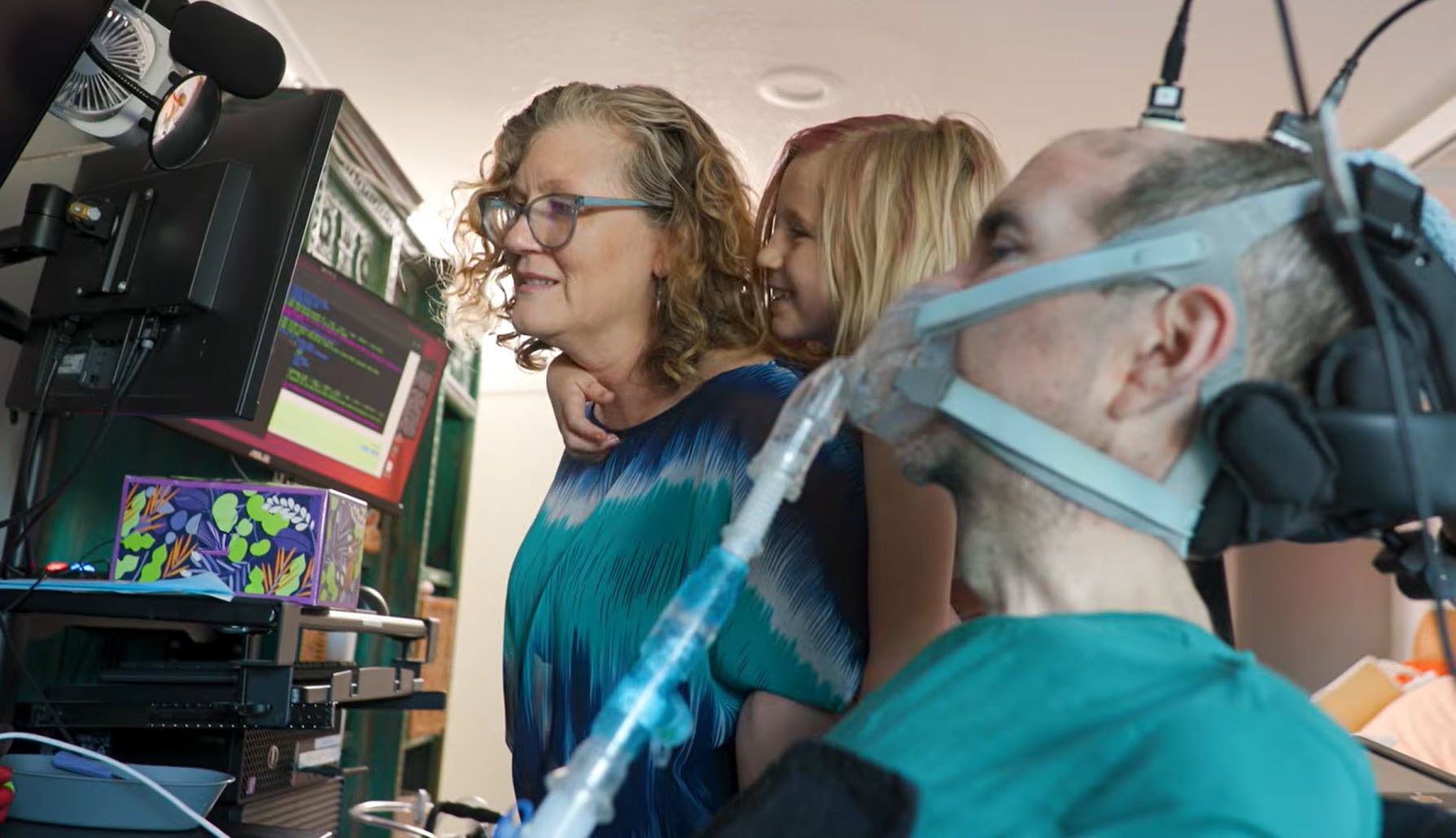
Researchers first tested the new technology in the home of Casey Harrell when he was a 45-year-old study participant. While Harrell’s thinking remained clear, muscle weakness due to ALS made speaking difficult.
The system used computer programs to decode Harrell’s brain activity into words when he attempted to speak. It pulled from a vocabulary of 125,000 words to display the decoded words on a computer screen. The system also spoke the words aloud using a digital version of Harrell's voice created from recordings of him before he lost the ability to speak.
Unlike other systems, this one allowed Harrell to rate the accuracy of each statement and make corrections by controlling a cursor on the system’s computer screen. The cursor was guided not by Harrell’s hand, but by his brain activity or eye movements.
During the first 280 days of the study, researchers visited Harrell's home to set up the system two to four times each week. Then, they taught his caregivers how to set it up, so Harrell could use the system whenever he wanted. After that, he used the system almost daily. After almost 23 months, he had used it for more than 3,800 hours of in-person conversations, video calls, email, and text messaging.
Across more than 180,000 sentences, Harrel rated 79% as correct or mostly correct. He was able to correct 13% of sentences. Over time, he could make longer and more accurate statements.
The study showed that caregivers could successfully set up the system on their own. A person with paralysis could then use it independently over long periods of time.
“It is something that allows me to communicate more in my natural way of communicating than any other technology that I have experienced,” Harrell says through the system.
While these results are promising, more work is needed. In addition to testing the system in more participants, researchers plan to use the large amount of data collected during the study to improve the system. They also plan to make it smaller, more durable, and more portable.
"For years, brain computer interfaces have lived in highly controlled research labs,” Brandman says. “This work shows that we may have crossed a threshold, by empowering a person with paralysis to speak on his own terms.”
—by Laura Manella, Ph.D.
Related Links
- Decoding inner speech from brain signals
- Brain-computer interface restores natural speech after paralysis
- Creating an artificial sense of touch
- Brain-computer interface helps paralyzed man speak
- How the brain produces speech
- Scientists translate brain activity into music
- Brain decoder turns a person's brain activity into words
- System turns imagined handwriting into text
- Advances in ALS
- Assistive Devices for People with Hearing, Voice, Speech, or Language Disorders
- BrainGate2: Feasibility Study of an Intracortical Neural Interface System for Persons With Tetraple…
References
Long-term independent use of an intracortical brain-computer interface for speech and cursor control. Card NS, Singer-Clark T, Peracha H, Iacobacci C, Hou X, Wairagkar M, Fogg Z, Offenberg EC, Hochberg LR, Stavisky SD, Brandman DM. Nat Med. 2026 Jun 15. doi: 10.1038/s41591-026-04414-6. Epub ahead of print. PMID: 42297978.
Funding
NIH’s Office of the Director; U.S. Department of Veterans Affairs; U.S. Department of Defense; A.P. Giannini Foundation; Burroughs Wellcome Fund Career Awards at the Scientific Interface; Achievement Rewards for College Scientists Foundation; ALS Association.