Clues to what causes multiple sclerosis
Research in Context September 23, 2026
Clues to what causes multiple sclerosis
Pointing toward better treatments
Multiple sclerosis is a disease where the body’s immune system attacks the central nervous system. There is no cure, although there are treatments that can reduce the number and severity of relapses. Scientists are studying the disease’s underlying biology to find new clues about its causes and better ways to treat it.

Multiple sclerosis (MS) is the most common disabling neurological disease affecting younger adults. It affects nearly 1 million people in the United States and 3.1 million worldwide. It typically strikes people between the ages of 20 and 40 and affects women more often than men.
MS is an autoimmune disorder. Autoimmune disorders are caused by the body’s immune system attacking healthy tissue by mistake. Nerve fibers are coated with a mixture of protein and fatty acids called myelin. This acts like electrical insulation, preventing nerve impulses from losing strength as they travel.
“MS involves attack of the myelin sheath, which is similar to stripping the coating off of wires such that they short‑circuit,” explains Dr. William Robinson of Stanford University. Because of this, nerve signals have trouble reaching their intended destination.
Symptoms of MS can vary depending on where the damage occurs. Common symptoms include vision problems, muscle weakness, spasm, tingling, numbness, pain, difficulty with balance, bladder control problems, and dizziness. Other symptoms can include fatigue, mood changes, and problems with concentration, thinking, learning, and memory.
MS can follow different courses. When first diagnosed, most people experience what’s called relapsing-remitting MS. Symptoms appear as recurrent attacks or relapses. These may last for days or weeks and then go away for a while. The periods between attacks, called remissions, may last for weeks, months, or even years. Over time, however, the disease can evolve into progressive MS. This is where symptoms gradually get worse over time even without relapses. Sometimes, MS may be progressive from the beginning, skipping the relapsing-remitting phase altogether. But this is less common.
While there is no cure for MS, there are treatments that can reduce the number and severity of relapses. Treatments can also delay disease progression and the development of long-term disability.
“The prognosis for MS is much less dire than it was 30 years ago,” says Dr. Daniel Reich of the NIH’s National Institute of Neurological Disorders and Stroke. “But it still results in substantial neurological disability, substantial loss of productivity and quality of life, and huge costs to the medical system.”
NIH-funded researchers are working to better understand the causes of MS and the mechanisms that drive its progression. This will hopefully lead to more effective treatments and, one day, a way to stop its progression entirely.
Chronic inflammation and MS
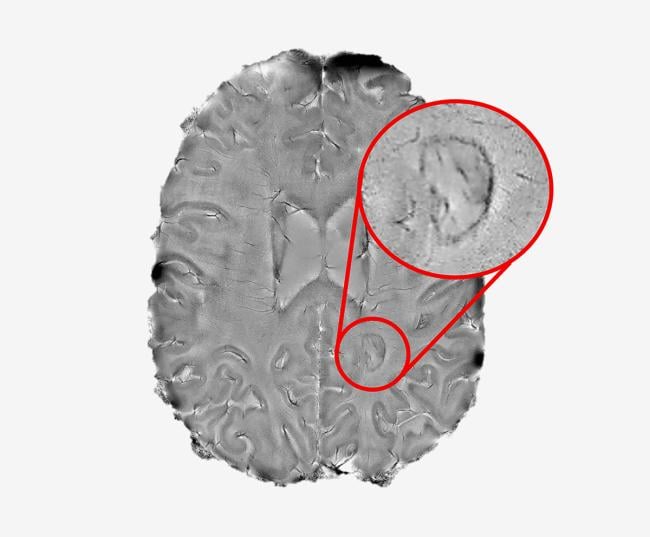
The immune attack on myelin forms patches of scar-like tissue, called lesions, in the brain. These lesions appear as spots on MRI scans that help doctors to diagnose MS and track the extent of damage over time.
Symptom relapses can occur when a new lesion appears, although many lesions don’t cause any symptoms. Newly formed lesions feature active inflammation and myelin loss. But after the initial inflammation, sometimes the inflammation goes away. The missing myelin may or may not get repaired but doesn’t continue to deteriorate. Other times, low-level inflammation may continue for many years, causing the lesion to slowly expand. Many of these chronic active or “smoldering” lesions can be identified by the accumulation of iron around the lesion rim. This makes the rim appear dark on certain MRI scans.
An NIH research team led by Reich found that having more chronic active lesions was associated with greater physical and mental disability. Among 192 people with MS, more than half had at least one chronic active lesion. Those with 4 or more such lesions were 60% more likely to have progressive MS than those without the lesions. They also developed motor and cognitive disabilities at a younger age, and certain regions of the brain were smaller. The chronic active lesions remained stable or expanded over time, even as other lesions shrank. This suggested that these lesions contribute to ongoing damage in progressive MS. Of note, chronic active lesions were observed in people receiving several effective therapies. This suggests that current treatments may not fully suppress this local inflammation.
Reich and his former postdoctoral fellow Dr. Martina Absinta, now at Humanitas University in Milan, Italy, wanted to understand the mechanisms driving the inflammation in chronic active lesions. Working with colleagues at NIH and elsewhere, they used a technique called single-nucleus RNA sequencing, which shows which genes are active in individual cells. This allowed them to identify where various cell types were in the brain lesions, and how the lesions differed from healthy brain tissue.
The research team analyzed more than 66,000 cells from post-mortem human brain tissue. They found that the rims of chronic active lesions contained more immune cells than healthy brain tissue. Among these immune cells were microglia—a brain-specific type of immune cell—whose gene activity resembled that found in other neurodegenerative diseases. They called these cells, which were found almost exclusively in chronic active lesion rims, “microglia inflamed in MS (MIMS).”
Among the genes activated in MIMS were various markers of inflammation. These included components of the complement system, a part of the immune system that helps the body get rid of germs and damaged cells. The results suggested that the complement system may be a key driver of inflammation in MIMS. Whether these findings can translate into new MS treatments remains to be seen. Drugs that target complement are still in the early stages of development. Many have difficulty getting into the brain.
Reich has been working on clinical trials of drugs that target an enzyme called BTK, which plays a key role in the function of certain immune cells, including B cells and microglia. Results have shown potential for reducing disability in progressive MS, but the effects have been modest.
According to Reich, the best approach right now is to treat MS aggressively early on. “If you can prevent new lesions from forming, the more you do that, the less likely you are to have this chronically inflamed state,” he says. “And young people deal with repair much better after inflammation. They may have a very aggressive inflammatory presentation, but they heal better once we get past that.”
A viral trigger

Several factors are known to increase the risk of MS. These include a family history of MS, vitamin D deficiency, and smoking. However, what causes MS is still uncertain. Prior research suggests that it may be triggered by a viral infection. The most likely culprit is the Epstein-Barr virus (EBV). EBV is one of the most common viruses, infecting about 95% of people. EBV is the most common cause of infectious mononucleosis, or mono. But most people infected with EBV never have any symptoms.
People who’ve had mono have an increased risk of developing MS. People with MS also have high levels of antibodies against EBV. And EBV has been reported in MS brain lesions. This suggests a link between EBV and MS. But these links don’t prove that EBV is the cause of MS.
An NIH-funded research team led by Dr. Alberto Ascherio of the Harvard T.H. Chan School of Public Health sought to find more conclusive evidence that EBV causes MS. To do so, they used the fact that active-duty US military personnel have blood samples taken every two years as part of routine medical screenings. Serum left over from these screenings is stored in the Department of Defense Serum Repository. The repository now contains samples from more than 10 million people.
“It's sort of a natural experiment,” Ascherio explains. “You follow these young men and women over time, and then you look at who gets MS, and you compare the people who got infected with the virus to people who did not.”
The researchers found 955 cases of MS in military medical records between 1993 and 2013. Of these, 801 had samples available from before disease onset that could be tested for EBV. The scientists also tested samples from more than 1,500 people with similar characteristics who did not develop MS.
The results were striking. The team found a much higher rate of EBV infection among people who developed MS than among those who didn’t. All but one of the people with MS tested positive for EBV before disease onset. Infection with EBV increased the risk of MS by more than 30-fold. The researchers found no comparable association between MS and any other human viruses examined.
The team also measured levels of neurofilament light chain (NfL), a biomarker for nerve damage. They found that increases in NfL usually preceded MS diagnosis. But this increase occurred only after EBV infection. These results suggest that EBV infection may play a critical role in causing MS.
“Basically, EBV infection is required for the development of MS,” Robinson explains. The association between EBV and MS was far stronger than the association between MS and any other known risk factor.
No vaccine against EBV exists yet. But such a vaccine might also protect people against MS.
“If you could prevent infection with the virus, it might prevent 99% of the cases of multiple sclerosis,” Ascherio says.
Still, only a small fraction of people infected with EBV develop MS. So, other factors must be involved, too.
“People shouldn't worry about having had mononucleosis or their children having had mononucleosis,” Ascherio advises. “The risk of developing multiple sclerosis, even after mononucleosis, is well below 1%.”
Mistaken molecular identity
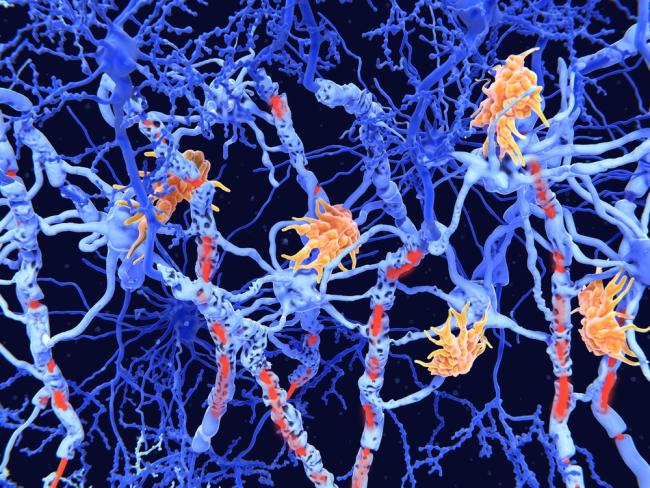
How could EBV infection lead to MS? One clue is that immune cells called B cells appear to play an important role in MS. These cells are responsible for producing antibodies, which recognize and bind to bacteria and viruses. People with MS have high overall antibody levels in their cerebrospinal fluid. Additionally, drugs that deplete B cells are among the more effective therapies for preventing MS relapses. This suggests that some antibodies that bind to EBV might also bind to some of the body’s own cells.
An NIH-funded research team led by Robinson at Stanford investigated this possibility. To do so, they sequenced antibody-producing genes from B cells of people with MS. They then measured the corresponding antibodies’ ability to bind various viral and human proteins. They found an antibody that bound both an EBV protein called EBNA1 and a human protein called GlialCAM. The latter is a protein found in the central nervous system, including in the cells that produce myelin, called oligodendrocytes. It’s also found in chronic active MS lesions. A fragment of GlialCAM resembled the site on EBNA1 that the antibody recognized.
The researchers tested other antibodies from people with MS and found several more that also bound to GlialCAM. Blood from people with MS produced strong immune reactions to both EBNA1 and GlialCAM. GlialCAM could also block the immune reaction to EBNA1. Work by other research groups revealed similar molecular mimicry between EBNA1 and other proteins in the brain.
In a later study, Robinson’s team compared antibody responses against EBNA1 and GlialCAM between 650 people with MS and 661 without MS. Those with MS had stronger reactions to both proteins, consistent with the earlier findings. The researchers then sorted participants based on whether they had a gene variant associated with increased MS risk. Among people with MS, those who had this variant had more antibodies against EBNA1 and GlialCAM than those who didn’t. The gene variant, antibodies against EBNA1, or antibodies against GlialCAM each increased MS risk. The more of these risk factors one had, the more this risk increased. Having all three increased the risk more than ninefold over having none.
The team further looked at cross-reactivity between EBNA1 and two other brain proteins. Like GlialCAM, stronger antibody reactions to these proteins were linked to greater MS risk. These antibody reactions further increased risk when combined with the gene variant and antibodies against EBNA1.
The findings suggest that molecular mimicry between EBNA1 and GlialCAM plays an important role in MS. This could explain how EBV infection could cause MS in some people but not others. A genetic risk factor for MS makes the formation of antibodies that can recognize both proteins more likely. Similar mechanisms could be involved in other autoimmune diseases. Yet it remains to be seen whether this insight will lead to new MS therapies.
Nonetheless, Reich is optimistic about the prognosis for people with MS. “We have really remarkable treatments that we didn’t have 30 years ago,” he says. “Our expectation is that people with MS should live a full life without reduced lifespan.”
—by Brian Doctrow, Ph.D.
Related Links
- Links found between viruses and neurodegenerative diseases
- Study suggests Epstein-Barr virus may cause multiple sclerosis
- A cellular map of brain lesions in multiple sclerosis
- Multiple sclerosis (MS)
- About Epstein-Barr Virus (EBV)
References
Association of chronic active multiple sclerosis lesions with disability in vivo. Absinta M, Sati P, Masuzzo F, Nair G, Sethi V, Kolb H, Ohayon J, Wu T, Cortese ICM, Reich DS. JAMA Neurol. 2019 Dec 1;76(12):1474-1483. doi: 10.1001/jamaneurol.2019.2399. PMID: 31403674.
A lymphocyte-microglia-astrocyte axis in chronic active multiple sclerosis. Absinta M, Maric D, Gharagozloo M, Garton T, Smith MD, Jin J, Fitzgerald KC, Song A, Liu P, Lin JP, Wu T, Johnson KR, McGavern DB, Schafer DP, Calabresi PA, Reich DS. Nature. 2021 Sep;597(7878):709-714. doi: 10.1038/s41586-021-03892-7. Epub 2021 Sep 8. PMID: 34497421.
Longitudinal analysis reveals high prevalence of Epstein-Barr virus associated with multiple sclerosis. Bjornevik K, Cortese M, Healy BC, Kuhle J, Mina MJ, Leng Y, Elledge SJ, Niebuhr DW, Scher AI, Munger KL, Ascherio A. Science. 2022 Jan 21;375(6578):296-301. doi: 10.1126/science.abj8222. Epub 2022 Jan 13. PMID: 35025605.
Clonally expanded B cells in multiple sclerosis bind EBV EBNA1 and GlialCAM. Lanz TV, Brewer RC, Ho PP, Moon JS, Jude KM, Fernandez D, Fernandes RA, Gomez AM, Nadj GS, Bartley CM, Schubert RD, Hawes IA, Vazquez SE, Iyer M, Zuchero JB, Teegen B, Dunn JE, Lock CB, Kipp LB, Cotham VC, Ueberheide BM, Aftab BT, Anderson MS, DeRisi JL, Wilson MR, Bashford-Rogers RJM, Platten M, Garcia KC, Steinman L, Robinson WH. Nature. 2022 Mar;603(7900):321-327. doi: 10.1038/s41586-022-04432-7. Epub 2022 Jan 24. PMID: 35073561.
Antibody reactivity against EBNA1 and GlialCAM differentiates multiple sclerosis patients from healthy controls. Sattarnezhad N, Kockum I, Thomas OG, Liu Y, Ho PP, Barrett AK, Comanescu AI, Wijeratne TU, Utz PJ, Alfredsson L, Steinman L, Robinson WH, Olsson T, Lanz TV. Proc Natl Acad Sci U S A. 2025 Mar 18;122(11):e2424986122. doi: 10.1073/pnas.2424986122. Epub 2025 Mar 10. PMID: 40063790.
Tolebrutinib in nonrelapsing secondary progressive multiple sclerosis. Fox RJ, Bar-Or A, Traboulsee A, Oreja-Guevara C, Giovannoni G, Vermersch P, Syed S, Li Y, Vargas WS, Turner TJ, Wallstroem E, Reich DS; HERCULES Trial Group. N Engl J Med. 2025 May 15;392(19):1883-1892. doi: 10.1056/NEJMoa2415988. Epub 2025 Apr 8. PMID: 40202696.
Global prevalence of multiple sclerosis surpasses 3 million: 2024 update of the Multiple Sclerosis International Federation Atlas of MS. King R, Marrie RA, van der Mei I, Banwell B, Makaroff L, Rijke N, Helme A. Mult Scler. 2026 Sep 3:13524585261479954. doi: 10.1177/13524585261479954. Online ahead of print. PMID: 42693747.