DNA organization changes in Alzheimer’s disease, aging
August 25, 2026
DNA organization changes in Alzheimer’s disease, aging
At a Glance
- New research showed the 3D organization of DNA in cells changes in Alzheimer’s disease and aging.
- The results suggest the changes may contribute to altered gene activity observed in Alzheimer’s and aging.
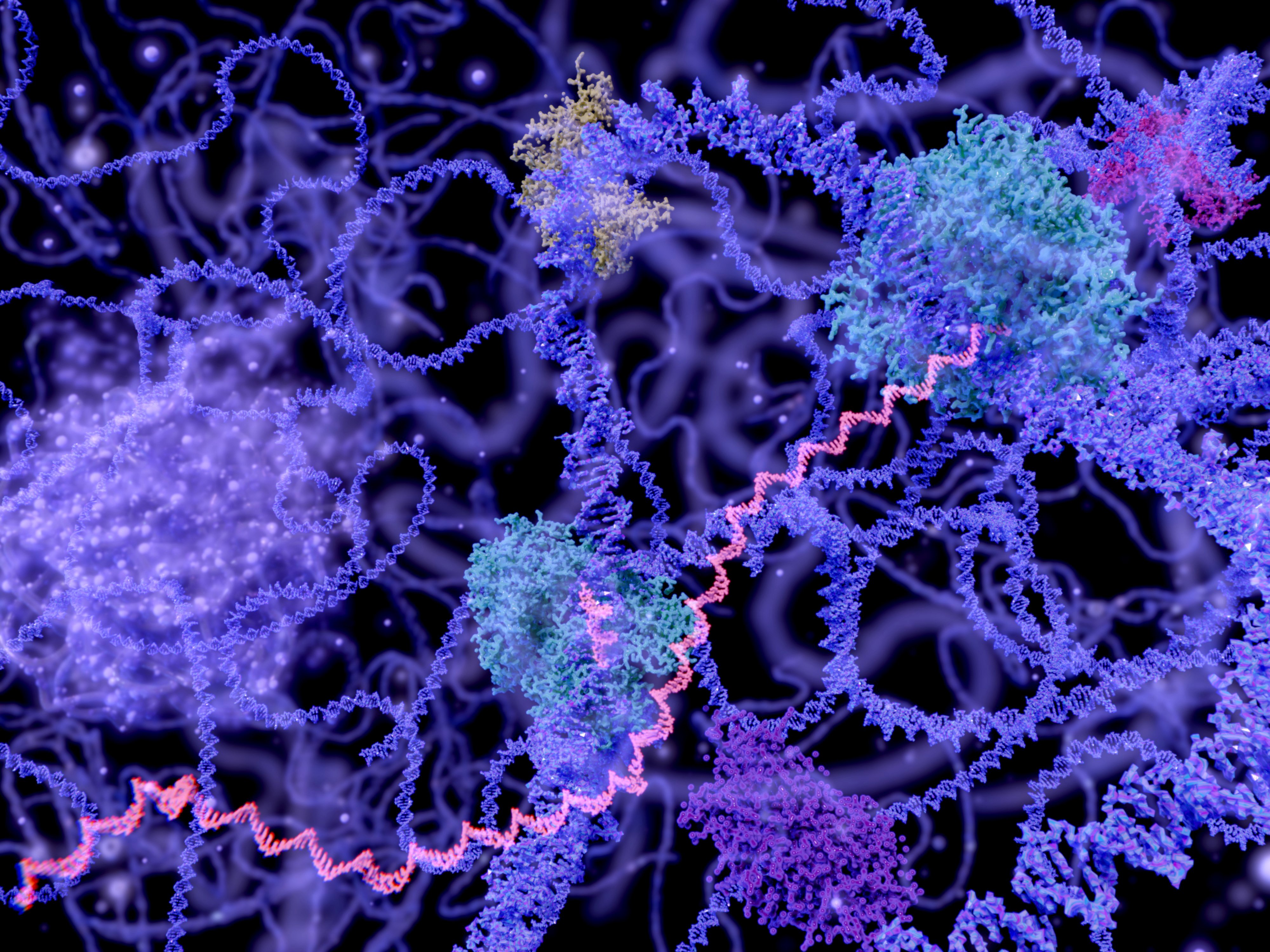
Changes in DNA—either to the DNA sequence itself or the chemical marks on it—can tip the balance between health and disease. The way that DNA folds up to fit inside the cell nucleus also plays a role. But little is known about how the 3D organization of DNA changes in specific diseases.
The NIH Common Fund’s 4D Nucleome (4DN) program supports research to study the 3D organization of DNA in the nucleus over time, a 4th dimension. Researchers aim to understand how the 3D folding of the genome, the entire set of DNA instructions found in a cell, changes with age and illness. The program also funds the creation of new tools that can be used for that research.
A research team funded in part by this program explored how 3D genome folding changes in Alzheimer’s disease. Led by Drs. Hansruedi Mathys of the University of Pittsburgh, Zhijun Duan of the University of Washington, and Jian Ma of Carnegie Mellon University, the team explored whether such changes are linked to gene activity disruptions in Alzheimer’s. The study was published as part of a package of 4DN-supported studies in Science on July 23, 2026.
The researchers examined postmortem brain tissue from people ages 75 years or older, 10 of whom had Alzheimer’s and 10 of whom did not. They looked at many types of cells from a part of the brain called the prefrontal cortex, which undergoes major changes in people with Alzheimer’s.
The scientists found DNA folding differences between cells obtained from the two groups. Distant parts of the DNA sequence were close to each other more often in cells from people with Alzheimer’s than in cells from people without Alzheimer’s. And neighboring parts of the sequence were close together less often.
Reorganization of chromatin, the mixture of DNA and proteins inside a cell’s nucleus, drove these spatial changes. Some chromatin is dense and contains DNA that is hard to access, so the genes remain inactive. Other chromatin contains more loosely packed DNA with active genes. The two types of chromatin usually stay separate. But the study showed that in people with Alzheimer’s DNA from the different types of chromatin physically mingled with each other more than usual.
In general, increased chromatin mingling was associated with reduced gene activity. Activity in genes involved in several processes that help neurons work particularly decreased. However, activity in genes important for producing energy and making RNA increased with greater chromatin mingling.
A separate 4DN-supported study found that aging may have similar effects on DNA’s organization. A team led by Dr. Xiangmin Xu of the University of California, Irvine, and Drs. Nathan Zemke and Bing Ren of the University of California, San Diego looked at cells from the brain’s hippocampus, which is important for forming and recalling memories.
They found an overall loss of 3D genome organization with age. This coincided with age-related changes in gene activity and chemical marks to DNA. Together, the findings reveal how gene activity patterns change with age. This in turn may contribute to brain inflammation and dysfunction. These results were also published in Science as part of the same package of 4DN-supported studies.
The results suggest that both Alzheimer’s and aging, a major risk factor for Alzheimer’s, involve changes in how DNA is packed within the nucleus. More research is needed to figure out how those changes might affect the activity of genes and cell health.
“Alzheimer’s disease cannot be understood one layer at a time,” Ma says. “The genome’s 3D structure is a fundamental regulatory layer that helps to connect DNA sequence to gene activity.”
— by Brandon Levy
Related Links
- Alzheimer’s proteins in blood linked to midlife cognition
- Blood test predicts start of Alzheimer’s disease symptoms
- Measuring aging with brain scans
- Can we slow aging?
- Tracking organ aging and disease
- Blood test for early Alzheimer's detection
- 4D Nucleome (4DN) program
- Epigenetics
- Transcriptome fact sheet
- Alzheimer’s and dementia
- About Alzheimer’s (CDC)
- Genome in motion: Mapping the nucleus in health
References
Single-cell multiomics connects 3D genome and transcriptome alterations in Alzheimer's disease. Zhang Y, Lu X, Kunisky AK, Alam S, Tang J, Zhang R, Wang S, Zhang H, Baroudi J, Ichcho W, Jia D, Ghorbanikalateh S, Ghorbanikalateh S, Wang S, Bennett DA, Mathys H, Duan Z, Ma J. Science. 2026 Jul 23;393(6809):eadz1652. doi: 10.1126/science.adz1652. Epub 2026 Jul 23. PMID: 42490473.
Epigenetic and 3D genome reprogramming during the aging of human hippocampus. Zemke NR, Lee S, Mamde S, Yang B, Berchtold N, Garduño BM, Indralingam HS, Bartosik WM, Lau PK, Dong K, Hsu E, Yang A, Tani Y, Chen C, Zeng Q, Ajith V, Tong L, Seng C, Li D, Wang T, Zhou J, Ecker JR, Glass CK, Cotman CW, Xu X, Ren B. Science. 2026 Jul 23;393(6809):eadt8307. doi: 10.1126/science.adt8307. Epub 2026 Jul 23.PMID: 42490474
Funding
NIH’s National Human Genome Research Institute (NHGRI), National Institute on Aging (NIA), National Institute on Drug Abuse (NIDA), National Cancer Institute (NCI), and the NIH Common Fund.