Immune cells cross blood-brain barrier during human aging
August 11, 2026
Immune cells cross blood-brain barrier during human aging
At a Glance
- Researchers found that some of the brain’s immune cells are replaced by immune cells from bone marrow as people age.
- The findings suggest that scientists might one day be able to use immune cells born outside the brain to deliver therapies for brain disorders.
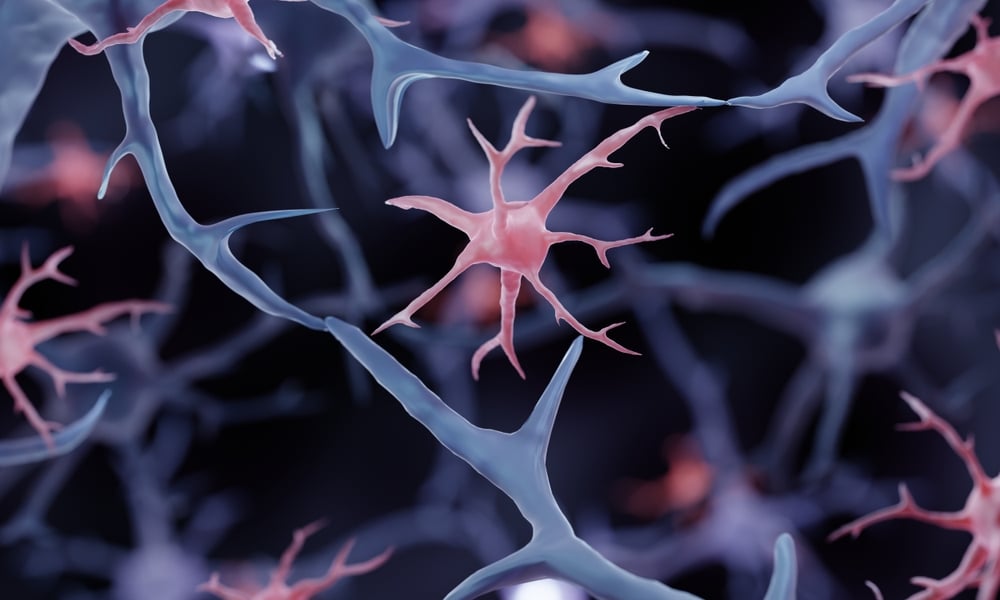
The brain contains specialized immune cells called microglia. The origins of microglia in humans have been a mystery. Most immune cells form from stem cells in the bone marrow and then enter the bloodstream. But a biological wall called the blood-brain barrier stops most cells and substances in the blood from entering the brain.
In mice, microglia precursor cells settle in the brain during embryonic development. Microglia can then be replenished throughout the lifespan from inside the brain. But in humans, recent evidence suggests that aging brains contain microglia that originate in the bone marrow. That would mean microglia or their precursors have the unique ability to cross the blood-brain barrier. However, it’s not clear how common this might be.
An NIH-funded research team including Drs. Julia Belk, Howard Chang, and Siddhartha Jaiswal of Stanford University investigated the origins of microglia in the human brain. The research was published in Nature on July 30, 2026.
The bone marrow stem cells that produce blood and immune cells acquire unique sets of mutations throughout life. These mutations are passed on to the cells they produce. As people age, some of these mutated stem cells can multiply faster than others. This produces sets of blood and immune cells that are genetically distinct. That process, called clonal hematopoiesis, allowed the scientists to trace whether a cell was born in bone marrow.
The team searched for cells in brain tissue with the same mutations that cells in blood acquired through clonal hematopoiesis. The only way both sets of cells could share those mutations is if both came from bone marrow.
When the researchers examined postmortem brain tissue from 20 older adults, they found each one had cells that shared mutations with cells in the individuals’ blood. This provided the first clear evidence that cells born in bone marrow often enter the brain in older adults.
The cells in the brain tissue that came from bone marrow resembled microglia in many key ways. And they made up a large share of the microglia in the brain tissue. Also, brain tissue from the older individuals had more microglia that came from bone marrow than brain tissue from the younger individuals. This suggests that microglia formed from marrow-derived cells migrate to the brain over the course of people’s lives.
The team also analyzed brain tissue and blood from a study participant who had received a bone marrow transplant. The brain tissue contained microglia with the same mutations as the transplanted marrow cells.
Having found that peripheral blood cells contribute to microglia, the researchers wondered whether clonal hematopoiesis might be linked with the risk for Alzheimer’s disease. Analyzing the DNA of tens of thousands of people showed that most types of clonal hematopoiesis were linked with reduced risk of Alzheimer’s disease.
The study’s results show that bone marrow-derived cells contribute to microglia as people age. Since the blood-brain barrier stops many therapeutic molecules from entering the brain, stem cell transplant may provide a way to get such treatments into the brain.
“We have discovered a massive influx of immune cells from the blood into the human brain during aging,” Belk says. “Our findings suggest new opportunities to engineer peripheral immune cells to treat or prevent neurological diseases.”
— by Brandon Levy
Related Links
- Sleep and exercise may reduce mutation-driven inflammation
- How exercise can protect against Alzheimer’s
- Engineered immune cells target Alzheimer’s disease protein
- Can we slow aging?
- Alzheimer's gene contributes to blood-brain barrier breakdown
- Your body’s disease defenses
References
Somatic mutations reveal the ontogeny of microglia in human aging. Belk JA, Zhang Y, Reilly EE, Shi Q, Liu DD, Womack-Gambrel N, van der Linde M, Ma L, Paul D, Enciso AM, Kalluru R, Weiss J, Li R, Eastman AE, Zhu C, Chakravarthy A, Bukhari S, Bhattacharya D, Raj S, Richard D, Brioschi S, Chrostek MR, Nachun DC, Arends CM, Gopakumar J, Tengesdal IW, Bynum A, Mitchell S, Sandor K, Zhang W, Vardarajan BN, Cobos I, Born DE, Zhang W, Vardarajan BN, Cobos I, Born DE, West RB, Brunet A, Colonna M, Bharani KL, Vogel H, Montine TJ, Latimer CS, Weissman IL, Matusiak M, Hooper JE, Keene CD, Chang HY, Jaiswal S. Nature. 2026 Jul 30. doi: 10.1038/s41586-026-10939-0. PMID: 42239322.
Funding
NIH’s National Institute on Aging (NIA), National Cancer Institute (NCI), National Institute of Mental Health (NIMH), National Institute of Neurological Disorders and Stroke (NINDS), and National Heart, Lung, and Blood Institute (NHLBI); National Science Foundation; U.S. Department of Defense; Ludwig Cancer Research; Stanford University; Burroughs Wellcome Fund; Howard Hughes Medical Institute; Walter Benjamin program; Allen Institute for Brain Science; University of Washington School of Medicine; Weill Neurohub.