Manipulating gene activity to reverse aging
February 24, 2026
Manipulating gene activity to reverse aging
At a Glance
- Altering levels of certain molecules called transcription factors reversed some of the effects of aging in mice.
- The findings show the potential of targeting transcription factors to counter age-related illnesses.
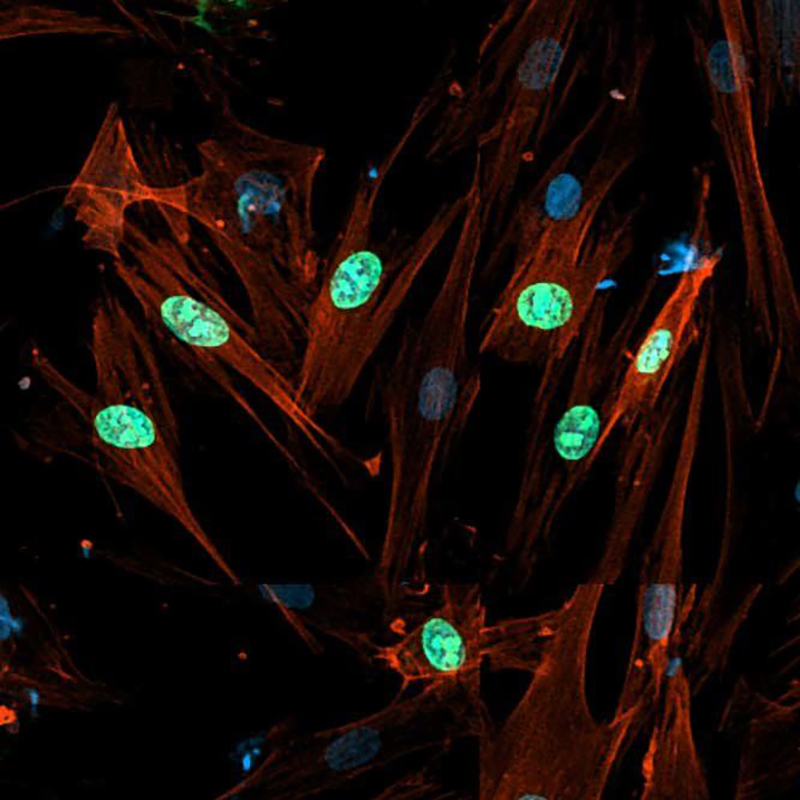
The activity levels of many genes change as we age. Some of these changes contribute to age-related diseases. Slowing or reversing these changes, then, might help people stay healthier for longer.
Molecules called transcription factors influence how genes are expressed, or turned off and on. Changing levels of a single transcription factor could affect many other genes that drive aging and its health consequences. But only a few such transcription factors have been found thus far.
An NIH-funded team of researchers, led in part by Drs. Changhui Deng, Saul A. Villeda, and Hao Li of the University of California, San Francisco, searched for transcription factors that could restore gene activity to a younger state. Their findings appeared in Proceedings of the National Academy of Sciences on January 9, 2026.
The team developed a system for screening large numbers of transcription factors. First, they identified age-related changes in gene expression. To do so, they compared gene activity in young and old human cells called fibroblasts. Then they used computational tools to predict which transcription factors were most likely to influence the activity of those genes.
The team next altered the activity of the top 200 transcription factors, one by one, in aged fibroblasts. They measured the resulting changes in gene activity and identified which transcription factor alterations reversed the most age-related changes.
The scientists chose four of the top transcription factors for further study. They examined what happened to older fibroblasts when they boosted levels of two transcription factors, EZH2 or E2F3, or reduced levels of two others, STAT3 or ZFX.
Each of these manipulations made cells multiply more and enhanced cell functions that tend to decline with age. Altering levels of the four transcription factors did not damage DNA or produce other changes associated with cancer.
Activity of the genes encoding EZH2 and E2F3 was higher in the livers of younger mice than those of older mice. Activity of the gene encoding STAT3 was lower in the livers of younger animals.
The scientists next altered the levels of one of these transcription factors in living mice. Increasing EZH2 levels in the livers of aged mice shifted thousands of other genes’ activities toward that seen in younger mice. It also reversed several negative effects of aging on the liver. Fat buildup and scarring decreased, and glucose tolerance improved. The intervention did not cause liver damage or changes in gene activity associated with liver cancer.
The results suggest that manipulating transcription factors could help to reverse some of the health consequences of aging.
“By altering gene expression using the transcription factors we identified, old fibroblasts behaved as if they were younger, and improved the health of old mice,” Li says.
The findings also hint that the team’s approach might be used to identify adjustments to transcription factors that could relieve other health problems as well. However, because transcription factors can affect many target genes, changing them can have unintended effects. Considerable study will be needed before the approach could be used in people.
—by Brandon Levy
Related Links
- Gauging biological age to predict future health
- Can we slow aging?
- Rejuvenating the immune system by depleting certain stem cells
- Tracking organ aging and disease
- Calorie restriction, immune function, and health span
- Exercise-induced protein may reverse age-related cognitive decline
- Blood protein signatures change across lifespan
- Eliminating senescent cells extends healthy life in mice
- Transcription
References
Systematic identification of single transcription factor perturbations that drive cellular and tissue rejuvenation. Sengstack J, Zheng J, Aghayev T, Bieri G, Mobaraki M, Lin J, Deng C, Villeda SA, Li H. Proc Natl Acad Sci U S A. 2026 Jan 13;123(2):e2515183123. doi: 10.1073/pnas.2515183123. Epub 2026 Jan 9. PMID: 41512022.
Funding
NIH’s National Institute on Aging (NIA); American Federation for Aging Research; CZ Biohub San Francisco.