Improving lung cancer detection
October 7, 2026
Improving lung cancer detection
At a Glance
- Researchers developed a protein-based MRI contrast agent that could detect a common lung cancer in mouse models and determine if it spread to other organs.
- With further development, the approach could help doctors detect lung cancer earlier and tailor treatment to the needs of each patient.
Lung cancer is the leading cause of cancer death worldwide. Often by the time patients get a diagnosis, the cancer has already spread to other organs. This spread, called metastasis, makes cancer harder to treat.
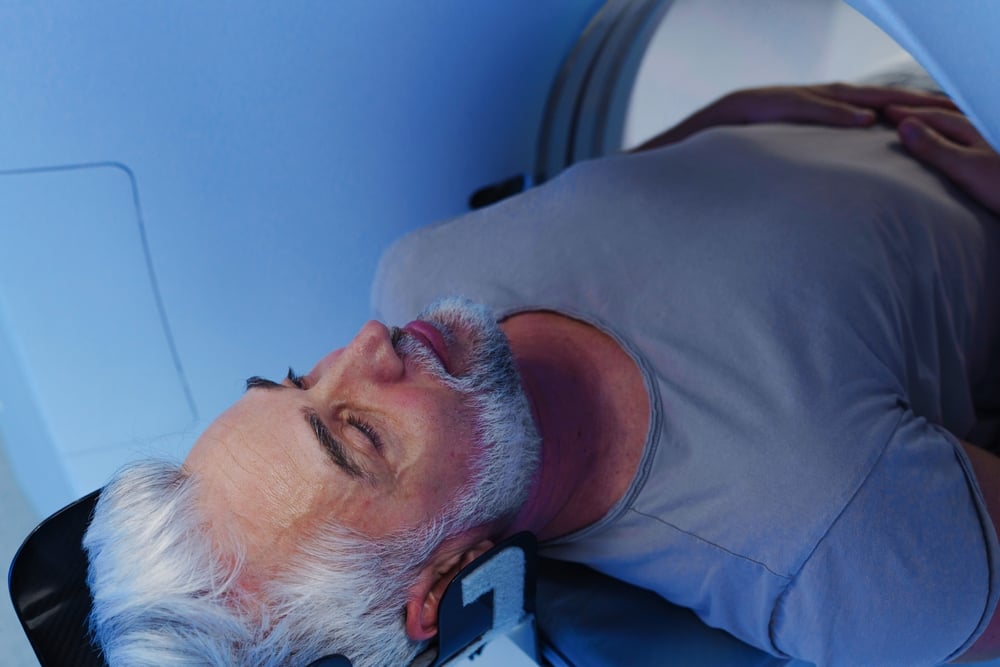
CT scans are widely used to detect and track lung cancer. MRI can also be used to examine tumors and cancer that has spread to other parts of the body. Contrast agents can improve the visibility of tissues and abnormalities such as tumors on both types of imaging scans. However, most conventional MRI contrast agents are not designed to target lung tumors. Very small lung tumors and the early spread of cancer cells to other organs can remain difficult to detect.
A group of NIH-funded scientists led by Drs. Jenny Yang of the University of Alabama at Birmingham and Georgia State University and Wei Zhou of the Emory University School of Medicine developed a new protein-based contrast agent that targets lung tumors. The research was published in Science Advances on September 9, 2026.
The new agent, called hProCA32.Collagen, binds strongly and selectively to a protein called collagen type I. Collagen is a structural protein found throughout the body that tends to build up around the edges of tumors. The researchers found high levels of collagen type I in human lung cancer tissue. They also found it at the invasive edges of certain lung tumors and metastases in mouse models. Previous research has linked increased collagen type I with tumor progression and poor outcomes in lung cancer. This made collagen type I a potential biomarker for identifying invasive lung cancer.
The team tested the collagen-targeting contrast agent in mouse models of lung cancer. These mice carried mutations associated with aggressive disease, treatment resistance, and metastasis. Tumors in the mice had collagen-rich tissue like those seen in human lung cancer samples.
MRI using the new contrast agent improved detection and measurement of small lung tumors in the mouse experiments. The targeted agent produced stronger tumor contrast than a commonly used MRI contrast agent. It also performed better than CT. MRI measurements of tumor size were consistent with measurements made from tissue samples.
The technique also helped detect very small metastases that had spread beyond the lungs. These included tumors in the adrenal glands and kidneys that CT scans failed to detect. Some of these metastases measured only a fraction of a millimeter.
Additional studies are needed to determine whether the new contrast agent is safe and effective in people. If it is, the approach could help doctors detect small lung tumors and metastatic disease earlier. It might also help improve cancer staging, track disease, and assess tumor aggressiveness.
“Our technology can detect tiny tumors and hidden metastases without exposing patients to radiation,” Yang says. “It also helps reveal how aggressive a cancer may be and how likely it is to spread, potentially reducing the need for invasive biopsies.”
—by Brandon Levy
Related Links
- Lung tumor signals may tamp down food intake
- Radiation from CT scans and cancer risks
- Detecting cancer
- Prevention and screening drive drop in cancer deaths
- Mapping how cancers form and spread
- When cancer spreads
- Magnetic resonance imaging (MRI)
- Computed tomography (CT)
- Lung cancer (CDC)
- Screening for lung cancer (CDC)
References
Early detection of invasive lung cancer and multiorgan metastasis by a collagen-targeted protein MRI contrast agent. Li D, Bamishaye O, Li S, Qiao J, Akinlotan F, Dorabadizare F, Chen X, Fan Y, Yuan Y, Gui Z, Hekmatyar K, Tóth É, Pallier A, Xu Y, Zhang Y, Ke X, Farris AB, Yang H, Wang JX, Carlisle J, Ramalingam SS, Kirberger M, Grossniklaus H, Yang X, Liu Z, Zhou W, Yang JJ. Sci Adv. 2026 Sep 11;12(37):eadz6815. doi: 10.1126/sciadv.adz6815. Epub 2026 Sep 9. PMID: 42715331.
Funding
NIH’s National Cancer Institute (NCI), National Institute on Alcohol Abuse and Alcoholism (NIAAA), National Institute of Biomedical Imaging and Bioengineering (NIBIB), National Institute of Diabetes and Digestive and Kidney Diseases (NIDDK), and Office of the Director (OD); Georgia State University.