Senescence-targeting nanoparticles may enhance immunotherapy
November 5, 2026
Senescence-targeting nanoparticles may enhance immunotherapy
At a Glance
- Researchers developed a nanoparticle treatment in mice to eliminate certain cells that can drive tissue scarring around tumors and prevent anti-tumor therapies from working.
- The approach made tumors more sensitive to therapies that boost the immune response to cancer and might one day be applied to humans.
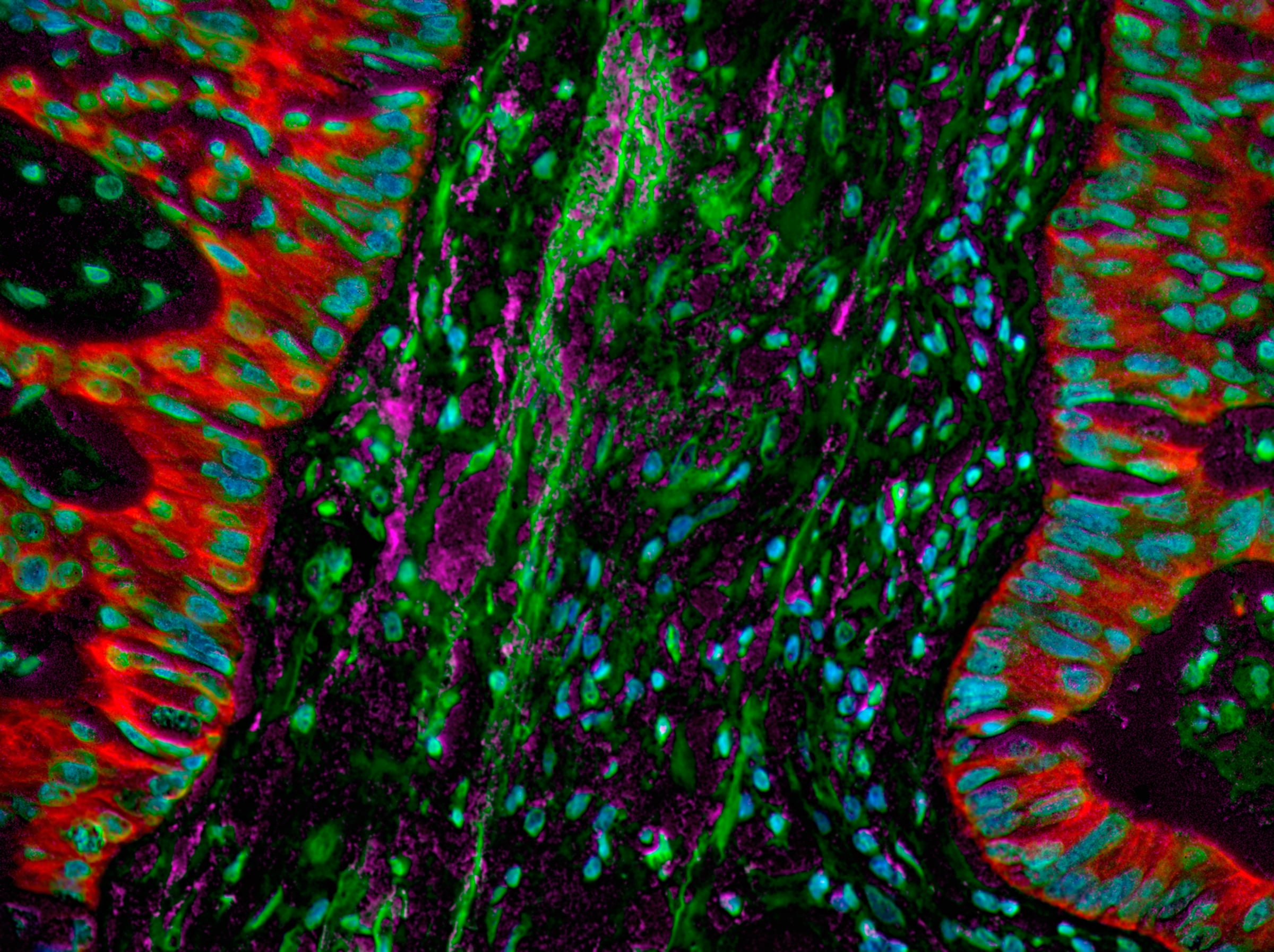
Chronic inflammation can fuel a form of scarring called fibrosis linked to cancer. Areas of fibrotic tissues often contain lots of damaged cells that no longer divide nor die off when they should. These “senescent” cells drive inflammation and fibrosis, and they inhibit nearby immune cells. As a result, tumors surrounded by fibrosis are harder to treat with immunotherapies that spur the immune system to attack cancer.
Killing senescent cells could reduce fibrosis and help cancer immunotherapy work better. But some senescent cells are needed for tissue repair, and it is difficult to destroy only the harmful ones.
A team of NIH-funded researchers led by Drs. Scott Lowe, Daniel Heller, and Aveline Filliol of Memorial Sloan Kettering Cancer Center created a therapy that selectively destroys the senescent cells that drive fibrosis. The study was published in Science on September 24, 2026.
The researchers found high levels of a protein marker called P-selectin on senescent cells in human and mouse tissues that were scarred by fibrosis. This provided an opportunity to selectively eliminate senescent cells in fibrotic tissues.
To target these cells, the researchers created tiny, drug-containing capsules called nanoparticles. They contained a substance that binds to P-selectin, so they would target cells with that marker. The nanoparticles were also loaded with drugs that kill or alter senescent cells.
In mice with lung or liver fibrosis, the nanoparticles acted specifically on a tiny population of macrophages, a type of immune cell. These macrophages had P-selectin and senescent features. The treatment reduced fibrosis without the toxic effects seen when the same drugs were given on their own.
Mouse liver and lung tissue affected by fibrosis contained few T cells, B cells, and dendritic cells. These are immune cells that help recognize and respond to threats. The nanoparticle treatment boosted the number of these cells in the fibrotic tissues. As a result, the treatment helped immunotherapy work much better against tumors growing in fibrotic tissues.
Tissue from several types of human tumors contained the same type of macrophage that the nanoparticles destroyed in mice. This makes it more likely that this strategy could improve treatment response in immunotherapy-resistant cancers in people.
“Immunotherapy can elicit amazing therapy responses — but right now it doesn’t work for the vast majority of patients,” Lowe says. “So anything we can do to make it work better and for more people is worth pursuing.”
—by Brandon Levy
Related Links
- Senescent cells mapped in human body over the lifespan
- Scientists find subtypes of senescence
- Mapping how cancers form and spread
- Identifying immune cells for personalized cancer immunotherapy
- Cancer
- Immunotherapy to treat cancer
References
Senescence-directed nanotherapy ameliorates fibrosis and overcomes immune exclusion in cancer. Hinterleitner C, Barthet VJA, Goldberg HV, Vogt KC, Perea AM, Hillger LR, Ruiz S, McHugh D, Ho YJ, Chaves-Perez A, Skamagki M, Flowers S, Styers HC, Rekhtman N, Zhuang X, Dessotti Barretto G, Li X, Watson JT, Luan W, Simon J, Tammela T, Gardner R, Rudin CM, Romesser PB, Bott MJ, Filliol A, Heller DA, Lowe SW. Science. 2026 Sep 24;393(6818):eaeg4791. doi: 10.1126/science.aeg4791. Epub 2026 Sep 24. PMID: 42784692.
Funding
NIH’s National Cancer Institute (NCI), National Institute on Aging (NIA), National Institute of Neurological Disorders and Stroke (NINDS), and National Institute of General Medical Sciences (NIGMS); National Science Foundation; Ludwig Center; Francois Wallace Monahan Fellowship; Cancer Research Irvington; Memorial Sloan Kettering Cancer Center; EMBO; Helen Hey Whitney Foundation; Kravis WiSE Fellowship; American Association for Thoracic Surgery; American Cancer Society; US-Israel Binational Science Foundation; Expect Miracles Foundation; Louis and Rachel Rudin Foundation; Geoffrey Beene Cancer Research Center; William H. Goodwin and Alice Goodwin; the Commonwealth Foundation for Cancer Research; Marie Josée and Henry Kravis Cancer Ecosystems Project; Cycle for Survival; Mark Foundation; Howard Hughes Medical Institute.